
And the Truth About Single, Double, and Triple Pane Glass
When you think of sauna in America, you often view large picture windows. However, for thousands of years saunas have had minimal windows and light relying on very small windows serving a ventilation function more than anything. Over in these European countries, people often scoff at US sauna design being less efficient and less functional than traditional sauna.
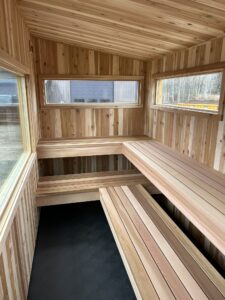
However, we found that much of this is a myth. With proper heat calculations and modern window technology, larger pictured windows provide excellent light, view, and reduced claustrophobia compared to the closed in design.
But Why Sauna Windows Are Debated at All?
There are two long-running debates in sauna building:
- Should a sauna have small windows or any windows at all?
- If you do have windows, should they be single, double, or triple pane?
These debates come up frequently, especially when comparing traditional European sauna design with modern American sauna design. We’ve found much of the confusion comes from applying home construction logic to sauna that behaves very differently. This is why custom home builders often make mistakes when designing and considering material and options for a sauna.
“Saunas are built to be overpoweringly hot. You’re not worried about long-term efficiency the same way you are in a house.” -Jayson Stolp
Custom Home Building has to consider long term stable eat with prolonged living environment, costs and living activities. Whereas sauna is far more specific and in some ways extreme. It must be able to go from -30 degrees all the way up to 150 degrees and then back down. It is a small space with dedicated heat source with this soul purpose. Though much of the basic ventilation and construction basics remain the same. Different topics are prioritized in ways that contrast home construction.
Debate #1: Traditional Small or No-Window Saunas vs. Large Window Saunas
The Traditional View: Small Windows or No Windows
In many traditional sauna cultures — especially Finnish and Slavic — saunas were built with minimal or no windows. The assumption is simple: windows equal heat loss.
Jayson acknowledges that this view still shows up today:
“There’s Sweeds, there’s Finns, there’s people on Facebook groups saying, ‘What is wrong with people? Why are your windows so massive? This is huge heat loss.’”
Our experience building and using saunas has led us to a clear conclusion about large windows and heat loss: it’s a mute point.
If you add a big window, you just size the stove accordingly. The issue isn’t the window—it’s failing to adjust the heater system to match the design. What people often do is build the sauna to a cubic-feet rating, then install a large window and still assume the stove is the right size. When the system is sized properly, the heat loss through a dual-pane window is very little.
Beyond performance, we pay close attention to how people actually feel inside a sauna. A lot of people feel claustrophobic in saunas, and having big windows completely eliminates that. We regularly hear people say they’ve never felt this comfortable in a sauna. Being able to see outside makes a huge difference.
Once the sauna is warm, windows don’t weaken the system. Once the heat’s in there, it holds it very well. In fact, on a sunny day, our saunas can get over 100 degrees just from the sun coming through the window.
From real-world builds and long-term use, our recommendation is simple: large windows do not meaningfully harm performance, comfort increases significantly, and stove sizing must match the design. It’s absolutely worth it if you have a great view. Why would you not?
Summary
- Large windows perform well when the heater is properly sized
- Dual-pane glass retains heat and prevents condensation
- Large windows improve comfort and reduce claustrophobia
- Single-pane glass causes moisture issues and is not used
Debate #2: Single vs. Double vs. Triple Pane Windows in Saunas
Why Single Pane Glass Fails in Saunas
Jayson is unequivocal on single-pane glass:
“Single pane, in my opinion, never makes sense. You have cold and hot hitting each other directly through that piece of glass. As soon as that hot meets the cold, it just turns into water. It runs down the pane of glass and you’re just going to rot your sill. It’s constantly wet. It’s constantly hard to see through. You’re always wiping the window.”
Why not go up to triple pane?
Triple-pane glass is often assumed to be “better,” but it rarely adds value in sauna construction.
“It very rarely would make sense to argue that triple pane is better in a sauna. You’re heating a sauna for two hours at a time. You’re not worried about efficiency over years like you are in a house. You don’t need triple pane. Saunas are built to be overpoweringly hot.”
Though triple pane is becoming increasingly popular in custom home construction with notable companies such as NS Builders featuring it heavily in their content. In the sauna world, it would be consider more of a luxury gimmick rather than someting we would find useful. The cost difference could go a lot further in other areas of the sauna material options such as clear cedar or upgraded heater design.
How BW Sauna Co. Builds and Installs Windows
We do not outsource our window builds. We build all of our windows in house. Rather than buying finished units from a window company, we build them from scratch. The glass itself is sourced professionally, and we order our glass panes from Minneapolis glass companies. This gives us precise control over the final window installation ensuring full control over moisture and temperature sensitive areas. Remember, this isn’t a window for a custom home. It will take on more harsh extremes.
Glass Specifications We Use as Standard
All of our sauna windows are built using glass that is:
- Tempered
- Dual-pane
- Argon gas filled
- Low-E coated on the exterior
All of our glass has a low-E coating on the exterior, which provides UV protection while maintaining clarity and performance in high-heat environments.
Customization and Design Flexibility
Because we build our windows in house, we can customize any size window, any design, and any style. This includes gray tints and mirror pane glass where you can’t really see inside at all.
We’ve also built non-standard shapes, including portal windows, large circular windows, angular designs, and could even do star-shaped windows if a project calls for it.
Installation for Movement, Safety, and Longevity
Sauna windows must handle expansion, contraction, and—in the case of mobile saunas—movement down the road. For that reason, we install the glass with space all the way around it so it can move. It is not direct contact wood pushing on glass, especially when the structure is bouncing during transport.
To secure the glass properly, we use VHB tape to hold the glass in place while allowing for controlled movement within the frame.
Recommended Checklist: What to Look for in Sauna Windows
Based on how we build and install windows, a proper sauna window system should include:
- Windows built specifically for sauna use, not standard house windows
- Tempered, dual-pane, argon-filled glass
- Low-E coating on the exterior for UV protection
- Installation that allows for movement and thermal expansion
- No direct wood pressure against the glass
- Secure mounting that accounts for heat cycles and transport
This system ensures the window performs safely, stays clear, and integrates properly with the sauna as a whole.
Feel free to call us, or shoot us a question over social media about any part of the sauna design process. We’d be happy to chat.