Sauna business ideas that hold up under daily use
Four directions operators build around, an interactive cost projection, and what running this actually looks like.
A sauna is not a piece of equipment. It is an asset. When an operator runs a sauna as a business, the unit has to do work that most residential saunas were never built to do. Daily heater cycles. Back-to-back sessions. Cleaning between bookings. Transport between sites. Customer experience that holds up in year five the way it did in year one.
This guide covers four directions operators are building businesses around, a calculator that lets you project startup costs and revenue for your own market, and an honest section on branding, marketing, and the gap between expectations and the work.
The market behind the question
Sauna sits inside one of the fastest-growing wellness categories. Operators entering now are catching the front edge of a category curve, not a trend that has already peaked.
$6.3T
Size of the global wellness economy in 2023, up from $4.4T in 2020.
Source: Global Wellness Institute
~7%
Projected annual growth of the global wellness market through 2028.
Source: Global Wellness Institute
10x
Estimated growth in U.S. public sauna and bathhouse locations between 2019 and 2024.
Source: Trade press coverage of the U.S. sauna category
The wellness economy is one of the fastest-growing consumer segments globally, and sauna has moved from niche amenity to category anchor inside that segment. The driver is not a single trend. It is the convergence of three: rising consumer spend on health and recovery, the spread of cold and contrast therapy from elite athletes into mainstream wellness, and the shift in short-term rental and resort markets toward differentiated amenities that justify premium pricing.
The implication for operators is that demand has not peaked. Markets that look saturated in 2026 will look like the early adopters in 2030. The operators building now are establishing brands in markets that will be five times larger by the end of the decade.
An operator buying their second mobile sauna almost always buys a better one.
Four directions operators build around
Each model places different demands on the unit. Each one also rewards different design choices in the build conversation.
Direction one
Mobile rental fleet
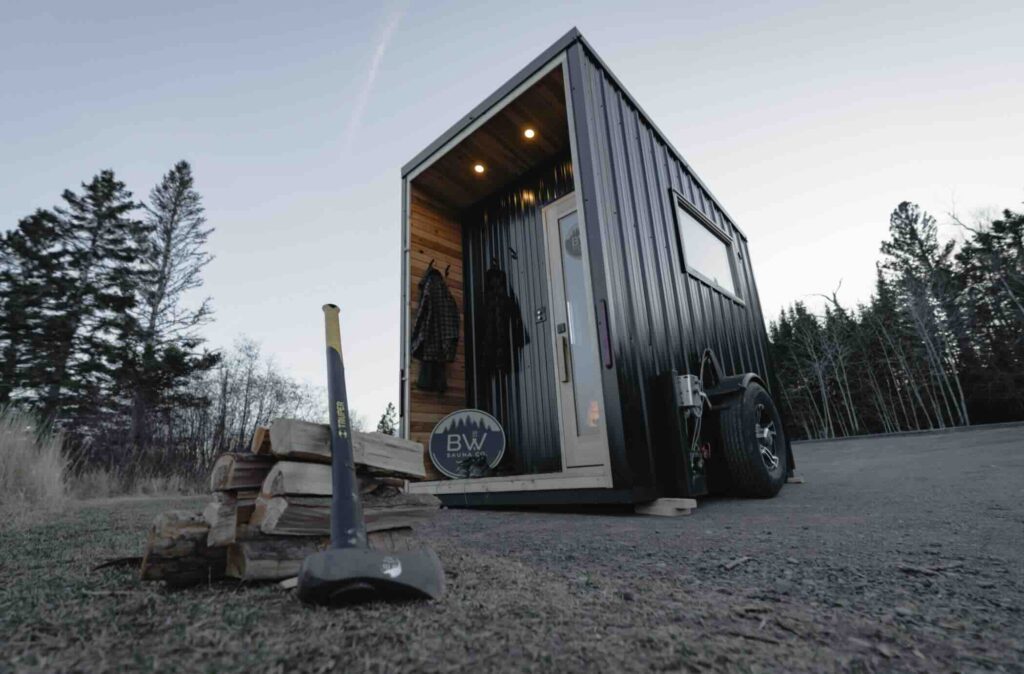
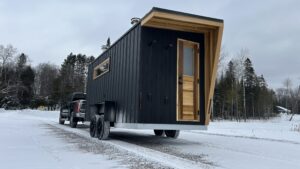
The operator owns one or more mobile units and delivers them to customer locations. Private bookings at homes, short-term rental properties, lake cabins, retreat venues. The unit travels. The customer does not.
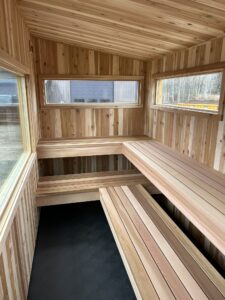
What it demands of the unit: wood-fired heater for off-grid sites, weatherproof exterior that handles transport and seasons, fast setup and teardown, removable benches for between-booking washdown.
Where the math works: markets with a strong short-term rental belt, lake or resort communities, regions with a wellness-engaged customer base willing to pay $200 to $400 per delivered session. Booking calendar density is the single biggest revenue lever.
Direction two
Event and pop-up activation
The operator brings the sauna to events: festivals, sporting events, corporate retreats, wellness pop-ups, brand activations. Higher per-session throughput, often shorter sessions, ticketed entry or per-person pricing.
What it demands of the unit: larger capacity (typically 8 to 12 person), commercial-grade heater sized for back-to-back high-volume sessions, visible branding surfaces, durable build that survives repeated setup and teardown.
Where the math works: operators with existing event relationships or willingness to build them, markets with year-round event calendars, brand sponsorship potential. Lower revenue per session, much higher session volume.
Direction three
Fixed-site boutique operation
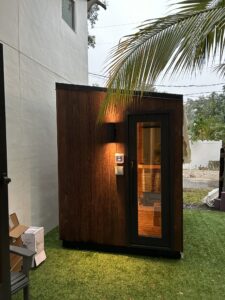
The operator parks the unit at a single site and runs it as a destination. Backyard sauna club, wellness studio addition, boutique spa, hotel amenity, lakefront sauna house. Customers come to the unit.
What it demands of the unit: finished interior that matches the brand experience, electric heater option (if power is available), permanent siting infrastructure, customer-facing finishes that hold up under daily use without looking worn.
Where the math works: markets where the operator can drive traffic to a fixed location, urban or near-urban wellness markets, properties where the sauna anchors a larger experience.
Direction four
Corporate and workplace wellness
The operator serves businesses, not individual customers. Mobile units delivered to office courtyards for employee wellness days. Long-term sauna installations in corporate wellness centers. Sauna packages for team retreats and offsites. Partnerships with co-working spaces.
What it demands of the unit: mobile delivery capability, professional brand presentation, insurance and liability coverage suitable for corporate clients, scheduling flexibility for one-off events.
Where the math works: markets with a dense employer base, regions with active corporate wellness budgets, operators with B2B sales orientation. Lower deal frequency, higher per-deal value.
Cost and revenue projection
Project your startup math
Adjust the inputs to model your market. The defaults are industry-typical estimates, not BW-specific numbers. Your actual results will depend on your market, your booking calendar, your pricing strategy, and execution. Every output is a projection.
BW units start at around $40,000 and go up with custom options.
Marketing, insurance, branding, business setup, first-season operating cushion.
Mobile delivered private bookings often run $200 to $400 in active markets.
Mature operators run 8 to 15 per week. New operators ramp from 2 to 5.
52 for year-round operators, 30 to 40 for seasonal markets.
Fuel, maintenance, insurance, marketing, platform fees. Typically 25-40%.
These numbers are projections built from industry-typical estimates, not guarantees and not BW-specific revenue claims. Operator results vary widely by market, season, fleet size, pricing strategy, marketing execution, and demand timing. Most operators take 6 to 18 months to ramp into mature booking volume. Use this calculator to test scenarios, not to underwrite the business plan.
Branding is the unit and what surrounds it
The brand of a sauna business is not a logo. It is the entire customer experience. The booking flow. The communication before the session. The unit when the customer arrives. The temperature when they walk in. The seam work in the corner of the bench. The water bottle they were handed. The way the operator follows up.
Every one of those touchpoints is the brand. The unit itself is the largest single one. A sauna that looks tired, smells musty, or has visible build shortcuts is doing brand damage every session. A sauna that looks and feels like it was built by people who care about it does the opposite.
The build choices that protect the customer experience over time are the same choices that protect the brand. Eight-layer wall assembly that lets the cavity breathe. Removable benches that get a real washdown between sessions. Metal siding that does not fade in year three. Interior finish that matches a custom home, not a backyard kit. These are not premium upgrades. They are the floor for a brand that customers come back to.
Photography is non-negotiable
Sauna is a visual business. Customers book what they can picture themselves inside. Operators with professional photography of their unit, their setups, their happy customers (with permission), and their settings convert dramatically better than operators relying on stock or amateur photos. Budget for a photo shoot in the first season. It pays back inside a few bookings.
The name and the story
The strongest sauna brands tell a specific story. A geographic anchor (the name of a lake, a region, a watershed). A founder story tied to a tradition. A specific experience promise. Generic names (“Premium Sauna Co”) work less well than specific ones (“Cold Lake Sauna”). The brand is the operator’s first marketing asset, and the choice gets harder to change after launch.
Marketing reality vs. marketing expectations
Most new operators expect Instagram to drive most of their bookings. Most established operators say it does not, at least not directly. The booking calendar fills through a mix of channels, and which mix works depends on the model.
What actually drives bookings
Mobile rental fleets: short-term rental partnerships, repeat private bookings, word-of-mouth referrals from past customers. Social is a top-of-funnel awareness tool, not a primary booking channel.
Event and pop-up operators: direct sales to event organizers and venues, sponsorship relationships, building a roster of recurring events. The first year is heavy on outbound sales.
Fixed-site boutiques: local search, Google Maps presence, walk-in traffic, partnership with wellness practitioners (yoga studios, therapists, gyms), email lists, membership programs.
Corporate operators: LinkedIn outreach, HR and benefits coordinator relationships, conference and trade show presence, referrals from corporate clients.
The marketing budget question
Realistic operators budget 10 to 20 percent of projected first-year revenue for marketing. That covers photography, a working website, paid acquisition tests, brand collateral, and the first event sponsorships or partnership investments. Year two typically drops the budget percentage as repeat customers and word of mouth carry more of the calendar.
The gap between expectations and the work
Here is the part most sauna business posts skip.
Running a mobile sauna business is hard work. It is physical, weather-exposed, customer-service intensive, and operationally demanding in ways that the booking-revenue math does not show. The honest version sounds like this:
The work nobody mentions in the brochure
Daily heater cycles. Wood-fired units need fires built every operating day. Electric units need to be turned on hours before the first session. The operator or staff has to be there, on time, every time.
Between-session cleaning. Removable benches, full washdown, restock water, reset the space. Every session. The faster and more consistent this is, the higher the throughput. The slower it is, the more it eats into operating hours.
Weather. Mobile saunas operate in real conditions. Rain, snow, cold, heat. Operators driving units to events at 5am in February are doing the work that fills the booking calendar in July.
Customer expectations. Some customers will love the experience and become repeat bookings. Some will arrive expecting a four-season hot tub or a luxury spa. Managing expectations during the booking flow is part of the job.
Maintenance. Trailers, heaters, door seals, chimneys, electrical, water systems. Daily commercial cycling means daily-cycling components. The operators who plan maintenance into their calendar do not lose weeks to surprise breakdowns. The operators who do not, do.
The work that pays
The operators who succeed at this are not the ones with the best Instagram. They are the ones who show up every session, deliver consistent customer experience, manage the unit like the business asset it is, and follow up with every customer to ask what could be better. The business is not built on the launch. It is built on the hundredth booking.
This is why the unit matters. A unit built for daily commercial cycling lets the operator focus on the part of the business that actually grows it: the customer experience and the bookings. A unit that is constantly developing problems forces the operator to do trade work instead of business work. Both jobs are full-time. Doing both at once is what burns operators out.
What every model has in common
Every sauna business runs on the same fundamental asset. The unit has to last. The interior has to hold up. The customer experience in year five has to feel like year one. The math changes between models. The build requirement does not.
BW mobile saunas start at around $40,000 and go up from there with custom options. Build times typically run four to eight weeks. Delivery is nationwide.
Three standard models: the Huron (6.5 x 10ft, 5 to 8 person), the Superior (6.5 x 12ft, 7 to 10 person), and the Gooseberry (6.5 x 14ft, 10 to 12 person). Custom sizes are available, from 6.5 x 8 compact builds to larger trailer saunas for commercial use.
Every quote comes out of a conversation about what the operator plans to do with the unit. Sizing, heater spec, interior wood, exterior finish, and trailer mechanicals all follow from the business model. For operators ready to talk through a specific build, the mobile sauna business page walks through how BW builds them.
Ready to talk?
Every BW build starts with a conversation
Tell us how you plan to run the unit. Sizing, options, and quote follow from there.