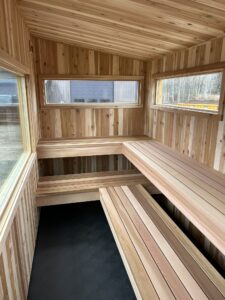


You cannot think about saunas the same way you think about houses.
After thousands of hours designing, building, delivering, and using saunas, one thing has become very clear to us: you cannot think about sauna building the same way you think about house building.
Most construction is designed around maintaining a consistent, controlled interior climate. Saunas are the opposite. Saunas are built to swing from extreme cold to extreme heat—sometimes from below zero to well over 180°F—over and over again, often in outdoor environments, and sometimes while being transported down the road. Materials that work fine in houses fail in saunas. Details that don’t matter much in residential construction suddenly matter a lot. And systems that look good on paper break down quickly when exposed to heat, moisture, and constant expansion and contraction.
What we build today is the result of years of trial, failure, refinement, and obsessive attention to how saunas actually behave in the real world.
This blog is the beginning of documenting what we’ve learned.
1. Saunas Are a System — Not a Collection of Parts
Every sauna we build is treated as a complete system. If you remove or change one component without understanding how it interacts with the rest, everything goes to crap. Heat retention, moisture control, comfort, and longevity all depend on how the system works together—not on any single “premium” material.
This is why we don’t try to chase the next best material. We’ve worked with many systems. Zip systems, mineral wool. exotic wood types and treatment processes. Over our years of experience, we’ve kept together materials that truly contribute to the larger systems, and tend to care less about gimmicks or materials that are marginal in their marginal contribution.
The heart of the lesson we would say, is “focus on how everything is affecting the main goal. Not everything is important. Know what is critical and what is not. Then go into your material selection.
Tip: Consider Clear Cedar for Benches Prevents Splitting.

Simple lesson showcases the different priorities sauna demands. We see often people opt for clear cedar cladding, and then use knotty cedar for their bench wood. After the dozens of sauna we’ve done, we find the opposite is best. Clear cedar (extra thiccc) 2×4 prevents splitting in extreme expansion and contraction conditions when people are sitting moving around.
The walls on the other hand tend to look more even and consistent with standard cedar stock especially when moisture is applied which increases contrast.
2. How Something Is Installed Matters More Than What It Is
We’ve learned that it’s not just about what materials you use—it’s about how they’re installed.
You can use a good product and install it incorrectly and create serious problems. You can also use a more basic product and install it correctly and end up with a system that performs extremely well.
This applies to everything: insulation, vapor control, windows, fastening methods, and exterior systems. Any system is only as good as the details behind it.
3. Sauna Construction Is Not About Over Engineering, It’s About Correct Engineering
It’s easy to chase buzzwords or overbuild certain components because they sound better on paper. But sauna building don’t need to be treated like high-efficiency homes designed to run at a steady temperature year-round.
Saunas need to heat up efficiently, retain heat during use, handle moisture correctly, and survive extreme cycles without failure. Once you understand that, many common myths—like large windows being “bad,” or triple-pane glass being necessary—fall apart quickly.