
What 10,000 hours of sauna building taught us

You cannot think about saunas the same way you think about houses.

After thousands of hours designing, building, delivering, and using saunas, one thing has become very clear to us: you cannot think about sauna building the same way you think about house building.

Most construction is designed around maintaining a consistent, controlled interior climate. Saunas are the opposite. Saunas are built to swing from extreme cold to extreme heat—sometimes from below zero to well over 180°F—over and over again, often in outdoor environments, and sometimes while being transported down the road. Materials that work fine in houses fail in saunas. Details that don’t matter much in residential construction suddenly matter a lot. And systems that look good on paper break down quickly when exposed to heat, moisture, and constant expansion and contraction.

What we build today is the result of years of trial, failure, refinement, and obsessive attention to how saunas actually behave in the real world.

This blog is the beginning of documenting what we’ve learned.

1. Saunas Are a System — Not a Collection of Parts

Every sauna we build is treated as a complete system. If you remove or change one component without understanding how it interacts with the rest, everything goes to crap. Heat retention, moisture control, comfort, and longevity all depend on how the system works together—not on any single “premium” material.


This is why we don’t try to chase the next best material. We’ve worked with many systems. Zip systems, mineral wool. exotic wood types and treatment processes. Over our years of experience, we’ve kept together materials that truly contribute to the larger systems, and tend to care less about gimmicks or materials that are marginal in their marginal contribution. 

The heart of the lesson we would say, is “focus on how everything is affecting the main goal. Not everything is important. Know what is critical and what is not. Then go into your material selection. 

Tip: Consider Clear Cedar for Benches Prevents Splitting.

usa made sauna

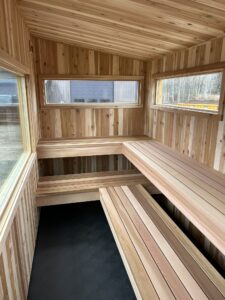
Simple lesson showcases the different priorities sauna demands. We see often people opt for clear cedar cladding, and then use knotty cedar for their bench wood. After the dozens of sauna we’ve done, we find the opposite is best. Clear cedar (extra thiccc) 2×4 prevents splitting in extreme expansion and contraction conditions when people are sitting moving around.

The walls on the other hand tend to look more even and consistent with standard cedar stock especially when moisture is applied which increases contrast. 

2. How Something Is Installed Matters More Than What It Is

We’ve learned that it’s not just about what materials you use—it’s about how they’re installed.

You can use a good product and install it incorrectly and create serious problems. You can also use a more basic product and install it correctly and end up with a system that performs extremely well.

This applies to everything: insulation, vapor control, windows, fastening methods, and exterior systems. Any system is only as good as the details behind it.

3. Sauna Construction Is Not About Over Engineering, It’s About Correct Engineering

It’s easy to chase buzzwords or overbuild certain components because they sound better on paper. But sauna building don’t need to be treated like high-efficiency homes designed to run at a steady temperature year-round.

Saunas need to heat up efficiently, retain heat during use, handle moisture correctly, and survive extreme cycles without failure. Once you understand that, many common myths—like large windows being “bad,” or triple-pane glass being necessary—fall apart quickly.


Outdoor saunas FAQs

Think about how you want to use the sauna, how much room you have, and how many people you want to fit. Compact models are great for small spaces, while larger models are better for entertaining guests or family use.
If you need more information on this topic, please visit “Ideal size for your custom outdoor sauna in minnesota.“.

Yes, outdoor saunas are designed to withstand the harsh Minnesota winters and can be used year-round. They provide a warm retreat in winter and a relaxing cool-down area during summer.

If you need more information on this topic, please visit “How to benefit from your outdoor sauna in every season.

While some sauna kits are designed for DIY installation, it is often recommended to use professional services to ensure it is installed safely and complies with local building codes, especially in Minnesota where weather conditions can affect installation.

If you need more information on this topic, please visit “Custom outdoor sauna kits.“.

Yes, a building permit is typically required for outdoor sauna installations in Minneapolis. Check with the local building department for specific requirements, as regulations can vary based on the size and location of the sauna.

If you need more information on this topic, please visit “Permit to install an outdoor sauna in minneapolis.

Regular maintenance includes cleaning the interior, checking and cleaning the heater, and ensuring proper ventilation. It’s also important to inspect and treat the wood exterior to protect against the elements.

If you need more information on this topic, please visit “How to take care of your outdoor custom sauna maintenance tips.

The position of your sauna should strike a balance between practicality, privacy, and good looks. By carefully designing and considering all of these features, you will increase the enjoyment and utility of your backyard sauna, transforming it into a true haven of relaxation and well-being.

If you need more information on this topic, please visit “How to choose the ideal spot for your backyard sauna.

The addition of a home sauna represents a strategic investment in both personal well-being and property value. By creating a sanctuary of relaxation and rejuvenation, homeowners can enhance the appeal, marketability, and overall worth of their properties. 

If you need more information on this topic, please visit “In home saunas.”

If you are the type that likes to participate and be connected to the process, then wood fire is for you. If you’re looking to maximize the relaxation and convenience of a sauna, electric might be a good option. 

If you need more information on this topic, please visit “Electric or wood burning stove what is better for a sauna.”

A good home sauna will cost you anywhere from $5,000 to $10,000 and custom saunas can reach upwards of $50,000.

If you need more information on this topic, please visit “How much does an home sauna cost a complete guide.”

Mark Funke
Mark Funke
The quality of the craftsmanship is 10/10. My clients have been loving the look of the unit and of course the good heat.
John Pederson
John Pederson
I've worked with Jayson (the owner) on about a half dozen builds now, he has always been extremely responsive, professional as well as fair and reasonable. I could not recommend BW more strongly.
buhrsmith
buhrsmith
The guys at BW are seasoned builders that know how to layout beautiful sauna spaces - for me, on a trailer. I most enjoyed how dedicated to the craft of building they are and they patience to guide me through a final build spec.