There is a question buyers should ask before they ask about price.
How long will this sauna run before it falls apart?
Most people don’t ask it. They look at the photos, the wood, the heater. They compare prices across saunas for sale. They pick something that looks good and works for now.
Three years later, the cedar is warping. The interior smells like sweat that won’t wash out. There are dark spots on the lower benches. The seams behind the heat shield have opened up. Heat is escaping. The bench is rocking.
The sauna isn’t broken in any one place. It’s failing everywhere at once.
This is the pattern with kit saunas, barrel saunas, and most of what shows up on Amazon. It’s a category of structure built to look right, not to last.
A sauna built correctly works on a different timeline. With normal maintenance, replacing benches when needed, refreshing stones, treating wood, the structure underneath can run for decades. The same way a well-built house does.
Why a sauna isn’t like any other backyard build
A shed needs to keep rain out. A modular pod needs to be structurally sound and watertight. A backyard office needs insulation and basic weatherproofing.
A sauna is subjected to conditions that nothing else in your backyard goes through.
Interior temperatures climb past 180°F. Humidity swings from dry to 30% to 60% within minutes when water hits stones. Walls go through that cycle hundreds of times a year. Every cycle drives water vapor outward through the wall assembly. Every cycle pulls cold air back in as the sauna cools.1
If you build a sauna with the same level of care as a shed, it fails. Not slowly. Quickly.
This is why a sauna can’t be evaluated on the same terms as the structures it looks like from the outside. A 6.5x10ft trailer-mounted sauna and a 6.5x10ft trailer-mounted office shed appear similar on the surface. They are not the same product. They cannot be built to the same standard. The layered wall construction inside a properly built sauna has no equivalent in any other prefabricated outdoor structure.
Failure modesThe four ways saunas die
Saunas don’t fail because the wood is cheap. They fail because moisture finds a path the builder didn’t account for.
Vapor migration through wall assemblies
Water vapor pushed into wall cavities condenses against the cooler side. Trapped moisture rots framing, breaks down insulation, and feeds mold growth.2 Once this starts inside a wall, you can’t see it. You smell it.
Mold and bacterial growth in interior wood
When interior cladding isn’t installed correctly, sweat and humidity work into the wood grain. If there’s no ventilation path or the wood isn’t sealed at the right points, biological growth begins. The sauna develops a smell that progressively gets worse no matter how much you clean it.
Bench failure
Benches take the most direct contact with sweat, body heat, and moisture. Cheap benches built from softwood with exposed fasteners and butt joints rot from the inside out. They get spongy underneath. They start to creak. The fasteners corrode.
Seam and joint failure
This is the most common mode in kit and prefab saunas. The points where wall panels meet, where the ceiling meets the wall, where the door frames into the wall, these are where vapor escapes outward and cold air pulls inward. When those joints aren’t sealed properly during construction, the wall assembly behind them gets wet and stays wet.
All four of these trace back to one decision: how the wall is built.
The vapor barrierThe hidden layer that decides everything
Every sauna has the same visible components. Interior cladding in cedar, aspen, or similar. A heater. Benches. Lighting. A door.
What separates a sauna built for 25 years from one built for 3 is what sits behind the cladding.
Specifically: the vapor barrier and how it’s installed.
A vapor barrier is a continuous layer that prevents water vapor from migrating from the hot, humid interior into the wall cavity. According to building science research, air-transported moisture accounts for the vast majority of water vapor movement in building cavities, which means a vapor barrier only works if it forms a continuous, sealed envelope.2 In a professional sauna build, this layer is:
- Aluminum foil-faced, oriented toward the sauna interior to reflect radiant heat back into the room. Polyethylene plastic sheeting and other residential vapor retarders are not suitable, they soften and degrade at sustained temperatures above 180°F3
- Continuous. No gaps, no untaped seams, no penetrations that aren’t sealed
- Lapped and taped with high-temperature aluminum tape rated for the conditions inside a sauna
- Maintained as a true vapor-tight envelope, not just a heat reflector
That last point is where most kit and prefab saunas fail.
A kit sauna assembled on a production line typically has the foil-faced layer present. It’s visible in the product photos. The buyer assumes it’s doing the job.
But the seams aren’t taped to a vapor-tight standard. The penetrations for lighting and the heater aren’t sealed. The corners where panels meet are stapled, not bonded. The vapor barrier is there. It isn’t sealing anything.
The result: water vapor pushes through every gap, every seam, every penetration. The wall cavity gets wet. It stays wet between sessions because there’s no path for that moisture to escape. The structure inside the wall starts to break down within the first year of regular use.
This is why kit saunas fail before they should. Not because the wood is bad. Because the seal isn’t real.
Watertight is not vapor tight
This distinction is the single most important concept in sauna construction, and it’s where the comparison to sheds and modular pods falls apart.
Watertight
Liquid water can’t pass through. A roof is watertight. A modular pod is watertight. A shed is watertight. Adequate for any structure exposed to rain and snow from the outside.
Vapor tight
Water vapor can’t pass through. Vapor is gaseous and moves through materials liquid water can’t.1 A wall can be perfectly watertight against rain and still allow vapor to migrate freely through it.
A sauna requires a vapor-tight interior envelope. The vapor pressure inside a hot sauna is the force driving moisture into the wall assembly, and only a properly detailed vapor barrier resists it. A backyard structure built to shed-quality standards is watertight. It’s not vapor tight. The wall behind the cedar is absorbing moisture every session.
Same construction, different timeline
The construction principles don’t change between residential and commercial use. What changes is how fast the consequences show up.
A backyard sauna used by one family three times a week reveals construction defects over five to ten years. A mobile sauna running commercial rentals seven days a week reveals the same defects in twelve to eighteen months.
This is why mobile sauna operators tend to be the most informed buyers in the market. They’ve seen what happens when corners get cut. They’ve watched competitors buy cheap and replace the unit twice in the time it takes a properly built sauna to need its first round of bench refresh.
The same applies to commercial hospitality installs. Airbnb hosts, cabin rental owners, ski resort wellness facilities, boutique hotel spas. Use intensity is high. Failure modes accelerate. The construction has to be right or the operator pays for it inside two years.
For the residential luxury market, the timeline is more forgiving but the standard isn’t. Custom home builds and luxury residential installations operate on lifetime expectations. From Minneapolis home installations to Asheville mountain properties, the buyer is not planning to replace this sauna. They want it to function in the home the same way a quality range, a steam shower, or a fireplace insert does. Permanent.
The construction has to be capable of that.
Kit vs. customWhat you’re comparing
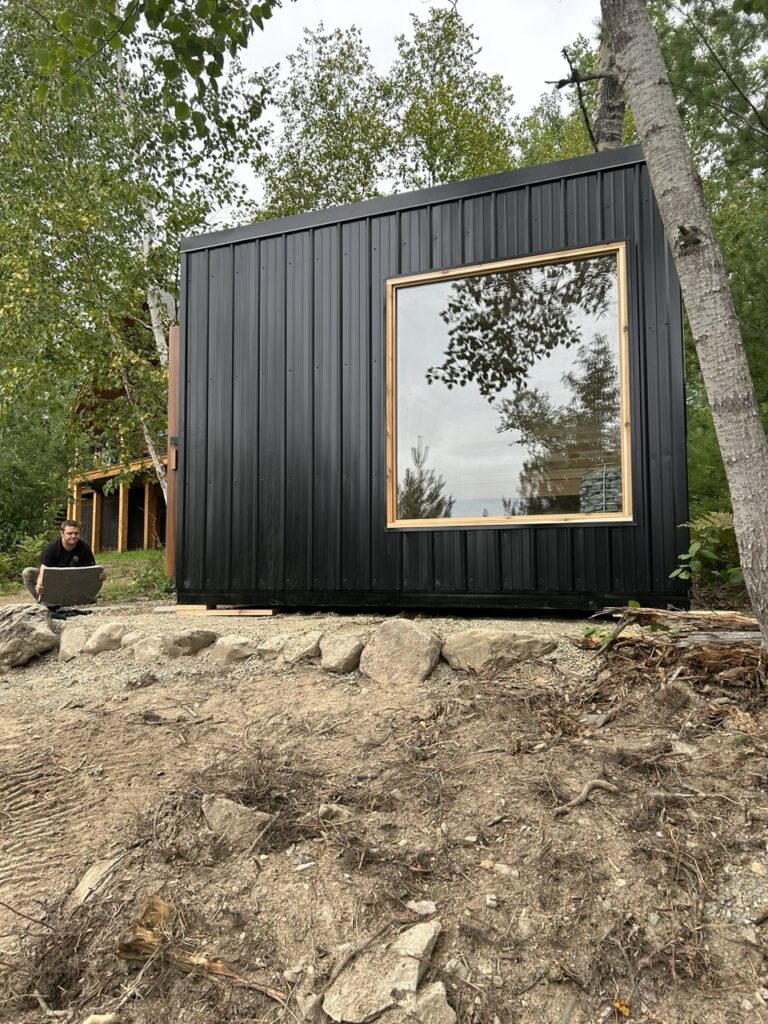
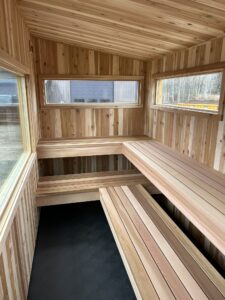
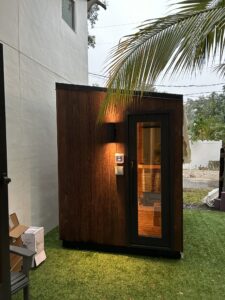
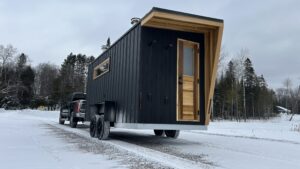
Marketing photos show two saunas that look the same. Corrugated metal exterior. Cedar interior. Heater on the wall. A glass door.
This is what’s different inside.
| Construction detail | Kit / prefab / barrel | Professionally built |
|---|---|---|
| Wall assembly | Production-line panels with stapled seams | Built and detailed on site by experienced builders |
| Vapor barrier | Foil present, seams not taped to vapor-tight standard | Continuous aluminum foil envelope, every seam taped, every penetration sealed |
| Heat shield air gap | Cladding mounted directly to wall or with inconsistent spacing | Wood furring strips maintain a consistent air gap between cladding and heat shield |
| Bench construction | Softwood, exposed fasteners, butt joints | Sauna-grade hardwood, concealed hardware, ventilated assemblies |
| Replacement cycle (residential) | 5 to 10 years before structural failure | Lifetime with normal maintenance |
| Replacement cycle (hospitality) | 2 to 4 years under daily commercial use | Built as a permanent business asset |
| Failure mode | Mold, smell, structural breakdown inside the wall | Wear components serviceable, core construction permanent |
What a permanent sauna is
A professionally built sauna is not a static object that lasts a specific number of years. It’s a structure with serviceable wear components and a permanent core. Some elements get replaced or refreshed over time. The core doesn’t.
This is the same principle that governs how long a well-built sauna lasts and the maintenance reality of custom sauna ownership over time.
Serviceable wear
What gets replaced or refreshed
- Sauna stones: replaced every one to three years depending on use frequency
- Interior cedar: light sanding or refresh as needed
- Benches: replaced if damaged, otherwise periodic sanding
- Door gaskets: replaced if compressed or deteriorated
- Heater: quality heaters from IKI, Kuuma, or Harvia run for many years and are replaced when warranted
Permanent core
What doesn’t get replaced
- The wall assembly
- The vapor barrier
- The structural framing
- The heat shield system
- The wood furring strips that maintain the air gap between interior cladding and heat shield
These are the structural and envelope decisions that determine whether a sauna runs for three years or thirty. They’re made once, during construction. They can’t be retrofitted later.
A house works the same way. The roof gets replaced. The paint gets refreshed. The flooring gets redone. The framing and the building envelope are permanent.
A sauna built correctly is a permanent installation with serviceable wear components. Built wrong, it’s a disposable structure with serviceable wear components that won’t outlast the wall behind them.
Evaluating a saunaWhat you can’t see when buying
This is the practical problem for any buyer comparing saunas for sale.
The visible elements, wood species, heater brand, bench layout, glass door, are easy to compare. Most buyers focus there.
The construction layers that determine longevity aren’t visible in any product photo. You can’t see vapor barrier seam tape. You can’t see whether the corners were detailed properly. You can’t see whether the furring strips between the heat shield and the cladding are installed correctly. You can’t see whether the penetrations for lighting and the heater were sealed.
This is why kit saunas can look identical to professionally built saunas in marketing photos. The exterior corrugated metal, the cedar interior, the heater. Visually, the same. The difference is sealed inside the wall.
Questions to ask any builder before you buy
- How is the vapor barrier installed and sealed at seams, corners, and penetrations?
- What sits between the interior cladding and the heat shield, and how is the air gap maintained?
- How are the ceiling-to-wall transitions and door frame detailed?
- What’s the construction backing or workmanship guarantee?
- Can the builder show me an in-progress build, not just finished marketing photos?
For more on what to look for when evaluating builders, how to choose the right sauna company covers the broader vetting process.
The mathThe cost of building it right once
BW custom-built saunas start around $40,000 and reach $60,000 or more depending on options. Build time is four to eight weeks. This sits well above the price of any kit or prefab sauna on the market.
The math works out a single way.
A professional sauna built once outlasts three to five kit saunas bought sequentially. The replacement cycle on cheap construction runs two to four years for hospitality use and five to ten years for residential. The total spend over a decade of cheap saunas matches or exceeds a single professional build, and the disposed units leave a trail of disposal cost, install cost, and lost rental revenue.
For a luxury residential build, the calculation is different. The residential buyer is not planning to replace this sauna. The decision is whether to install a fixture that performs for decades or one that requires removal and replacement before the rest of the house has aged into its first refresh.
For a mobile sauna operator, the calculation is operational. A unit built for hospitality use is a business asset, not a recurring purchase. The first build pays itself back through years of revenue the next builder won’t have to interrupt with replacement downtime. BW’s three standard mobile models, the Superior 12ft, Gooseberry 14ft, and Ontario 10ft, are all built to the same construction standard regardless of size or use case.
Both calculations land in the same place. Build it right once.
The right question
Decided before the first hot session
The right sauna question is not what does it cost. It’s how long does this construction last under the conditions a sauna goes through.
The answer depends on the layers you can’t see. The vapor barrier. The wall assembly. The detailing at every joint, corner, and penetration.
Built to the standard a sauna requires, the structure runs for decades. Built to the standard a shed requires, it runs for years.
The difference is permanent and decided before the first hot session.
Talk to BW about your build
Every BW sauna is built in Duluth, Minnesota, with the same construction standard applied to residential and commercial projects. Delivery is nationwide. Build times run four to eight weeks.
Sources and Further Reading
- Association of the Wall and Ceiling Industry. Building Science: Moisture Migration. Explains dew point, vapor pressure differential, and how vapor migration through wall assemblies degrades moisture-sensitive building materials. awci.org/technical-resource/building-science-moisture-migration
- U.S. Department of Energy, Building America Solution Center. Building Science Introduction: Moisture Flow. Documents how vapor moves into building cavities (air currents, diffusion, heat transfer) and notes that air-transported moisture accounts for the majority of water vapor movement in wall cavities. basc.pnnl.gov/information/building-science-introduction-moisture-flow
- Building Science Corporation (Joseph Lstiburek). BSD-106: Understanding Vapor Barriers. The foundational building-science reference on vapor barrier function, placement, and the difference between vapor retarders and air barriers in high-humidity wall assemblies. buildingscience.com/documents/digests/bsd-106-understanding-vapor-barriers