

A space blanket is a thin sheet of aluminized mylar.
Wrap one around someone in a survival situation and it reflects most of their radiant body heat back toward them. Their core temperature stabilizes. The material itself is doing almost no insulating. It’s redirecting heat that would otherwise dissipate into the air.
The foil vapor barrier inside a properly built sauna wall works on the same principle, scaled up and pinned to the framing.
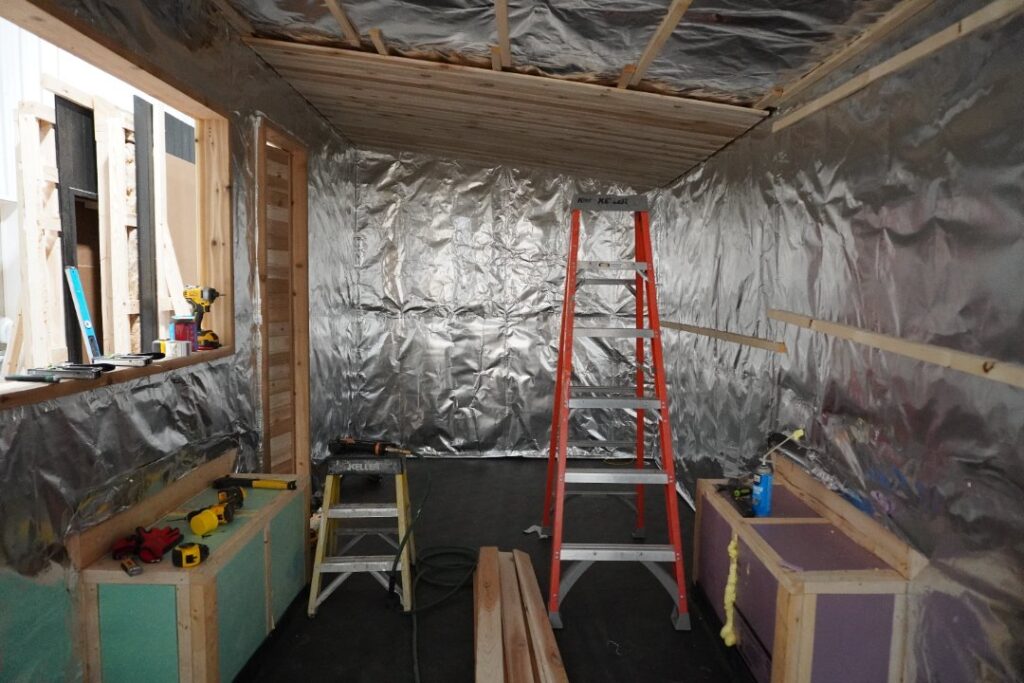
It’s not insulation, housewrap or a moisture barrier in the conventional sense. It’s a continuous reflective foil envelope that does two jobs at once. It bounces radiant heat back into the sauna, and it stops humid interior air from migrating into the wall cavity.
When this layer is detailed correctly, the structural envelope of a sauna can last for decades. When it isn’t, every other quality decision in the build is being undermined by what’s happening inside the wall.
This is a reference for what a foil vapor barrier does, what proper installation looks like, and what to check before or after a sauna goes up. It’s the deep dive on the single layer that drives most of the failure modes covered in the four ways saunas die in your yard.
Sauna walls work inside-out
A house is built outside-in.
Cladding goes on the outside. Under it, a water-resistive barrier like Tyvek or building paper. The function is to shed rain that gets past the siding. Inside the wall, fiberglass batts or another insulation product. On the warm interior side, drywall and paint. In cold climates, a vapor retarder is added on the interior face of the framing, behind the drywall.1
The whole logic of a house wall is straightforward. Rain hits the outside. The assembly drains outward. Vapor pressure usually moves from inside to outside in winter, the assembly is designed to allow that, and minor leaks dry out before they cause damage.
A sauna wall flips that logic.
Inside the sauna, you have temperatures past 180°F. You have relative humidity that spikes when water hits the stones. You have vapor pressure differentials hundreds of times higher than what a normal house wall ever sees, driving moisture outward through the assembly.
The cladding is the inside surface. The vapor barrier sits behind the cladding, on the interior face of the framing, with the foil oriented inward toward the room.
The function isn’t shedding rain that got past siding. The function is stopping intense interior vapor pressure from pushing humid air into the wall cavity, where it will condense, accumulate, and feed mold.
House wall
Built outside-in
Water-resistive barrier on the exterior. Function: shed rain. Vapor permeable so the wall can dry to either side.
Climate-appropriate vapor retarder, if any, on the interior face of the framing.
Minor leaks and condensation events dry out over time. The assembly tolerates imperfection.
Sauna wall
Built inside-out
Foil vapor barrier on the interior face of the framing. Function: stop intense interior vapor pressure from entering the wall.
Cladding installed on furring strips in front of the foil, with an air gap between them.
Imperfection is not tolerated. The foil envelope is either continuous or the wall is failing.
If you build a sauna wall like an exterior house wall, you’ve built it backwards. This is the most common mistake made by general contractors who haven’t built saunas before, and it’s why picking a builder who knows sauna construction matters more than any other specification decision on the project.
The materialFoil, perm ratings, and why other materials fail
The material is aluminum foil, typically bonded to a reinforcing scrim of fiberglass mesh or kraft paper to prevent tearing during installation. Roll widths run around 4ft. The foil face is what matters.
Building codes classify vapor retarders by their permeance, measured per ASTM E96 in U.S. perms. There are three classes:2
| Class | Permeance | Common materials |
|---|---|---|
| Class I | 0.1 perm or less | Aluminum foil (≈0.05 perm), polyethylene sheeting 6 mil and thicker |
| Class II | Greater than 0.1 to 1.0 perm | Kraft-faced fiberglass batts, vapor retarder primer |
| Class III | Greater than 1.0 to 10 perm | Latex paint, enamel paint |
Per IRC R702.7 and ASTM E96. Minnesota (climate zones 6 and 7) requires Class I or II vapor retarders on the interior side of frame walls.
Aluminum foil sits well below the 0.1 perm threshold. It’s among the most vapor-impermeable common building materials.
For sauna construction, the choice isn’t a preference. It’s the only material that works:
- Polyethylene plastic sheeting softens and degrades at sustained sauna temperatures above 180°F, and can release fumes when overheated.3 The vapor retarder used in standard residential framing is not suitable for sauna walls.
- Kraft-faced products use paper backing that fails in high heat.
- Vapor-permeable membranes like Tyvek and other housewraps are designed to allow vapor to pass through, which is the opposite of what a sauna requires.
- Aluminum foil handles temperatures well past anything a sauna produces, doesn’t off-gas, and reflects radiant heat back into the room as a free benefit.
Why the foil reflects, not just blocks
Aluminum foil is highly reflective in the infrared spectrum, which is the wavelength range of radiant heat. A space blanket reflects radiant body heat back to the body for the same reason a foil vapor barrier reflects radiant sauna heat back into the room. The surface emissivity is extremely low. Most of the radiant energy hitting it bounces back rather than being absorbed.
In a sauna, this matters in two practical ways.
The room heats faster. Radiant energy from the heater and the rocks that would otherwise be absorbed by the wall framing instead bounces back into the interior. Heat-up times go down. Steady-state temperature is reached with less energy input.
The framing behind the wall stays cooler. The wood structure inside the wall is not being directly baked by radiant exposure. Long-term, this matters for the dimensional stability and longevity of everything behind the foil. The layered heat shield system in a properly built trailer sauna works on this principle.
A foil layer is doing both jobs at the same time. Take it out and the wall loses its vapor protection AND its radiant reflector in a single move. This is the central reason every sauna construction tradition, from traditional Finnish builds to modern commercial mobile units, converges on aluminum foil as the interior wrap.
The envelopeContinuous, or it isn’t working
A vapor barrier only works if it’s continuous.
This is where the housewrap mental model fails people who haven’t built a sauna before. When you wrap a house, you can be reasonably sloppy with the seams. Tyvek tape gets pulled tight, overlaps go in the right direction, and the assembly drains outward if anything gets past. Small failures are recoverable.
A sauna foil vapor barrier doesn’t have that tolerance.
Vapor doesn’t behave like liquid water. It moves through any opening, regardless of orientation, regardless of size. Building science research documents that air-transported moisture accounts for the vast majority of water vapor movement in building cavities.4 If there’s an unsealed seam, an untaped overlap, or an unfilled penetration around a heater bolt, vapor passes through it.
Continuous means:
- Every seam between rolls is overlapped and taped
- Every corner where wall meets ceiling is wrapped and taped, not cut and butted
- Every penetration for lighting, heater fasteners, ventilation, and door framing is sealed
- Every tear, hole, or staple is taped over
The seam is where the wall fails
The tape is as important as the foil.
A foil vapor barrier installed with regular duct tape, painter’s tape, or off-the-shelf aluminum tape from a hardware store is going to fail. The tape needs to be:
- High-temperature aluminum foil tape rated for at least 250°F continuous service
- Backed with a high-tack adhesive designed to hold to foil surfaces at elevated temperatures
- Wide enough to lap each seam by at least 2 inches on each side
- Applied to a clean, dry foil surface, since any dust or condensation under the tape destroys the bond
Common acceptable products include Polyken 337, 3M 425, and equivalent contractor-grade high-temperature foil tapes. Generic “HVAC foil tape” is not the same product and is not rated for sauna conditions.
What proper taping looks like
- All overlaps run at least 2 inches
- All tape is applied to the foil-faced (interior) side, not behind the foil
- Tape is pressed firmly with a roller or hard hand pressure, not just smoothed by hand
- No air bubbles, no fishmouths at the tape edges
- All penetrations are taped over, then sealed at the fastener if applicable
This is slow, careful work. A production-line panel system can’t replicate it because the seams between panels only get sealed after the panels are installed in the field, and that’s the point at which most prefab and kit construction stops.
The air gapWhy the cladding doesn’t touch the foil
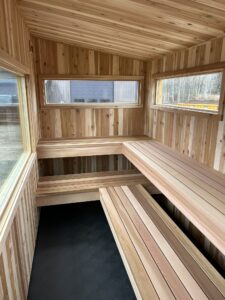
Behind the foil, you have framing. In front of the foil, you have the interior cladding in cedar, aspen, or another sauna-appropriate wood.
Between the foil and the cladding, there is supposed to be an air gap.
The gap is created by wood furring strips. Typically 3/4 inch nominal lumber, installed vertically over the foil, fastened through the foil into the framing behind. The cladding is then installed onto the furring strips, not directly onto the foil.
The gap does three things:
1. It preserves the radiant reflection function
Without a gap, the cladding sits flush against the foil and heat conducts directly into the wood, defeating the purpose of having a reflective layer. The foil needs an air space in front of it to bounce radiant energy back into the room rather than into the wood touching it.
2. It allows minor moisture to dry
Wood cladding will absorb some moisture during use. Without a gap, that moisture has nowhere to go. With a gap, it dries inward back into the sauna environment between sessions, rather than being trapped against the foil.
3. It allows the cladding to be replaced
This is the one most buyers don’t realize matters until they need it. Furring strips create a layer of separation that allows the cladding to be unscrewed and removed without disturbing the foil envelope behind it. Cladding refresh becomes a maintenance event, not a rebuild.
The trade-offThe unavoidable problem with furring strips
Furring strips have to be fastened to the framing behind the foil. That means fasteners going through the foil.
Every fastener is a potential penetration in the vapor barrier.
There is no way around this. The furring strips have to hold the cladding, and they have to be anchored in something structural, which means screws or nails passing through the foil layer. This is the construction reality, and it’s why builders who say their vapor barrier is “perfectly sealed” without acknowledging the furring strip penetrations don’t understand what they’re claiming.
Quality builders handle the trade-off several ways:
- Fasteners are placed only where studs or blocking exists behind the foil, so the wood-on-wood contact at the penetration is tight and the fastener compresses the foil between two solid wood surfaces
- Stainless or hot-dipped fasteners are used, since the small breach around a corroding fastener will open up over time
- Some builders pre-apply a continuous strip of high-temperature foil tape along the furring strip line before fastening, so the fastener passes through tape into the foil and back into the framing, sealing as it goes
- The total number of fasteners is minimized to what the cladding load requires, not over-fastened out of caution
Done right, this produces a foil barrier with a small number of well-sealed, well-located penetrations rather than hundreds of random staple holes and untaped seams. Mathematically, that is a near-complete envelope. Physically, it performs as one.
This is one of the construction details that simply cannot be inspected after the cladding goes on. It either was done right when the wall was built or it wasn’t.
The single layer that decides everything
The foil vapor barrier is the key variable that determines whether a sauna survives the decades or fails inside the warranty window of a kitchen appliance.
The framing behind it stays dry because of it. The cladding in front of it can be replaced because of it. The heater’s efficiency depends on it. The smell of the sauna in year five, year ten, year twenty depends on it.
It’s not the visible part of a sauna. It’s the part that decides whether everything visible still works ten years from now.
What to check before the cladding goes on
If you’re commissioning a custom sauna, evaluating a builder, or specifying one for a residential or commercial project, the vapor barrier installation should be inspectable before the cladding is installed. Many of these checks are visual. They take about ten minutes to walk through.
Vapor barrier verification checklist
- Material is aluminum foil-faced, scrim or fiberglass reinforced, oriented with foil toward the sauna interior
- All seams overlap a minimum of 2 inches and are taped with high-temperature aluminum foil tape
- Tape is rated 250°F continuous service or higher (Polyken 337, 3M 425, or equivalent)
- Wall-to-ceiling and wall-to-floor transitions are wrapped continuously, not butted
- All penetrations for lighting, heater mounts, ventilation, and door framing are visibly sealed
- No untaped tears, holes, or staple lines anywhere visible on the foil surface
- Furring strips installed over the foil with fasteners landing in studs or blocking
- 3/4 inch (or greater) consistent air gap maintained between foil and the back of the cladding
A builder who can describe and document this is doing the job. A builder who can’t is selling a finished appearance without the construction behind it.
The payoffWhat this system buys you in year fifteen
Interior sauna cladding is a wear surface. It absorbs sweat. It accumulates oils from skin contact. It darkens, weathers, and eventually shows enough age that an owner wants to refresh it.5
With normal use, this happens somewhere between 10 and 20 years for residential saunas, and sooner for high-use commercial mobile saunas running rental cycles. The cladding refresh is a defined maintenance event. The cladding comes off, the wall is cleaned, new cladding goes on.
If the construction underneath was done right, the vapor barrier and the wall assembly are untouched by this work. The foil envelope was sealed and protected behind the air gap. The framing has not been exposed to moisture cycles because the vapor barrier did its job. The cladding refresh is the only work that needs to happen.
If the construction underneath was done wrong, the cladding refresh is not a refresh. It’s a demolition.
Removing failed cladding from a sauna with a compromised vapor barrier reveals mold, rotted framing, deteriorated insulation, and a wall assembly that has to be rebuilt rather than re-clad. The cost difference is order-of-magnitude. The downtime difference, for a mobile sauna operator, is the difference between a week of work and a complete rebuild.
This is what people are buying when they buy a properly built sauna. Not the cedar. Not the heater. Not the trailer. They’re buying a wall assembly that survives the next 30 years of use with one cladding refresh somewhere in the middle. That outcome is decided by the foil layer behind everything they can see.
Closing
The thinnest, most important layer
A space blanket is a piece of foil. The reason it works isn’t that the foil is exotic. It’s that the foil is doing exactly one job, and the job is being done continuously.
A sauna foil vapor barrier is the same principle, scaled up and pinned to a wall. The material is aluminum foil. The job is reflecting radiant heat back to the interior and stopping vapor from entering the wall cavity. Every other layer in the sauna depends on this one being right.
The thinnest, lightest, least visible component in the entire build is the one that decides whether everything around it still works in twenty years.
Talk to BW about your build
Every BW sauna is built in Duluth, Minnesota, with the same foil vapor barrier system applied to residential and commercial projects, from custom home installations to mobile sauna rentals. Builds run four to eight weeks. Delivery is nationwide.
Sources and Further Reading
- Building Science Corporation (Joseph Lstiburek). BSD-106: Understanding Vapor Barriers. Foundational reference on vapor barrier classification, placement, and the distinction between vapor retarders and air barriers in wall assemblies. buildingscience.com/documents/digests/bsd-106-understanding-vapor-barriers
- 2021 International Residential Code, Section R702.7 Vapor Retarders. Defines Class I, II, and III vapor retarders by permeance per ASTM E96, and specifies climate zone requirements for interior vapor retarders in frame walls. Minnesota climate zones 6 and 7 require Class I or II. codes.iccsafe.org/s/IRC2021P2
- Haven of Heat. The Ultimate Guide to Sauna Insulation. Sauna-specific reference on material selection, including the failure modes of polyethylene at sustained temperatures above 180°F and the requirement for aluminum foil as the only suitable vapor barrier material for traditional sauna construction. havenofheat.com/blogs/sauna-guides/sauna-insulation-guide
- U.S. Department of Energy, Building America Solution Center. Building Science Introduction: Moisture Flow. Documents how vapor moves into building cavities through air currents, diffusion, and heat transfer, and identifies air-transported moisture as the dominant mechanism. basc.pnnl.gov/information/building-science-introduction-moisture-flow
- Association of the Wall and Ceiling Industry. Building Science: Moisture Migration. Reference on dew point, vapor pressure differential, and the long-term effects of trapped moisture on moisture-sensitive building materials. awci.org/technical-resource/building-science-moisture-migration