
Designing Harmony Between Home and Landscape
A sauna is not merely a backyard accessory. It is an anchor, a still presence, that changes how you move, see and congregate in your space.
When positioned mindfully, the sauna feels at home in the landscape, a destination of calm and conversation. When positioned dispassionately, it can feel out of place, a guest in your garden.
This article considers how to place a sauna and make it feel at home in your landscape, how to allow it to flow seamlessly with your architecture, your landscape, and your daily rhythm. Because the right placement doesn’t just build a structure. It builds an experience.
1. Privacy as the Foundation
Privacy is where every outstanding sauna experience starts.
Walking into the heat should usher you away from the world – invisible, undisturbed, and unhurried.
A sauna in the correct place should ideally provide you with a peaceful experience through careful design considerations.
- Screening: Use layers of trees, shrubs, fences, or elevation changes, to create a natural privacy.
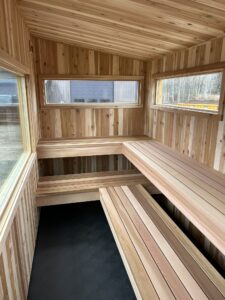
- Orientation: Windows should face quiet views, whether gardens, trees, or water, rather than opening into your neighbor’s kitchen light.
- Zoning: The sauna belongs where the space already feels intimate, tucked, not hidden.
Privacy isn’t just about blocking sightlines. It’s about creating a sanctuary.
2. Harmony with Existing Architecture
A sauna that feels foreign to its surroundings loses its magic.
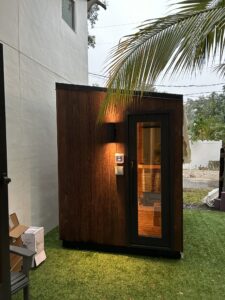
The secret is integration, echoing the forms, tones, and textures already present in your home or yard.
At BW, we craft saunas that mirror their context, from warm cedar siding to corten steel or refined metal-and-wood combinations.
Our goal is simple: to make your sauna feel meant to be, not added on.
3. Flow — The Journey is Important
The walk to and from the sauna is a ritual in its own right.
Walking to and from the sauna is a ritual in itself.
It should be an invitation to move organically, and in some way orchestrated: warm up, cool down, rest, and repeat.
Think about:
- Transitions: Where do you move from the water to the warm? From the plunge pool or shower into the heat?
- Surfaces: Will bare feet touch wet grass, or smooth stone, or wooden decking warmed by the sun?
- Resting zones: Where do you pause between rounds? A bench under a tree? A small patio to breathe the night air?
Each step should feel intentional, part of a rhythm that makes time slow down.
4. Views and Vistas
What you see outside the sauna influences how you feel inside.
A view of a treeline, lovely garden, or a mere hint of open sky turns a plain experience into an experience of contemplation. Seeing disarray, pavement, or close rooftops, is an entirely different story.
Think of every window as a painting. What do you want the picture for its viewer to be?
5. Common Design Mistakes
Even the finest sauna may be somewhat lacking in spirit depending on its location.
You should be aware of a couple of things:
- Competing focal points: Do not place the sauna someplace where there are visual rivals close or visible, such as pools, statues, or any other prominent item.
- Lonely by design: Don’t tuck your sauna so far away that it feels forgotten. Intention does not have to feel lonely.
- Seasonal neglect: In the winter months, a long, cold trip across icy ground can turn a lovely ritual into an unpleasant task.
A good design anticipates comfort in every season.
6. Zoning the Sauna
Think of your yard as an open-air house, with rooms defined not by walls, but by mood:
- Public Zone: The front yard, where impressions are made, not saunas placed.
- Private Living Zone: The backyard, deck, or patio, the heart of relaxation, and the ideal place for a sauna.
- Service Zone: Storage, gardens, and practical corners, best screened or softened with landscape.
Placing your BW sauna in the private living zone connects it naturally to the heart of your life outdoors, where comfort and community meet.
7. Neighbors and Community
A sauna may feel personal, but it still speaks to its surroundings.
Its shape, its light, even the faint sound of water or laughter, these things ripple outward.
Thoughtful placement respects that:
- Sightlines: Does it block or invade a neighbor’s view?
- Light and sound: Is its evening glow extending too far?
- Cohesion: Does its design relate with the larger rhythm of the neighborhood?
When done correctly, your sauna may not only improve the visual appeal of your home, but also the whole sense of place.
A Simple Self-Evaluation:
Before deciding on a place, consider the following:
Privacy:
- Can I move in and out without feeling watched?
- Do natural screens create a sense of retreat?
Integration:
- Does the sauna complement my home’s architecture?
- Does it enhance rather than disrupt my outdoor space?
Movement & Comfort:
- How do I move between water, heat, and rest, year-round?
- Are there places to linger between rounds?
Views & Orientation:
- What do I see when I sit inside? Does it inspire calm?
Context:
- Does the sauna feel like it belongs in this neighborhood?
- Would a guest sense harmony here?
Flexibility for the Future:
- Did I leave enough room for something new in the future? Like a deck, a pool, a new garden?
Final Word
Installing a sauna is more than a location or context; it’s a personal decision that involves taste and consideration.
A well-placed BW Sauna becomes the quiet centerpiece of an integrated backyard, private, harmonious, and deeply connected to its environment.
Ready to design your space with intention?
Let BW Sauna help you create a sauna that feels at home, in your yard, your routine, and your life. Call us today!