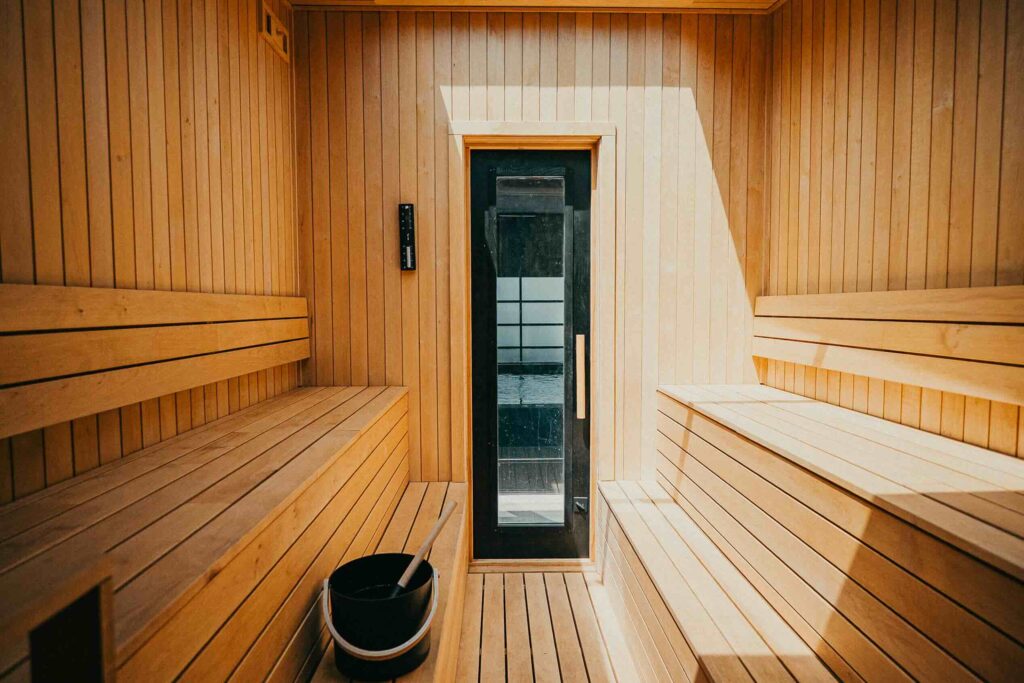
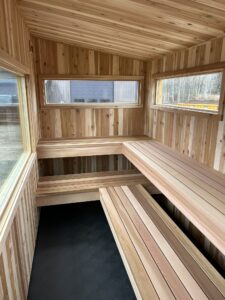


Most Upper Midwest cabin owners follow the same rhythm.
The cabin opens Memorial Day, runs hard through summer, hosts a few fall weekends, and gets closed up by Thanksgiving at the latest. Then it sits for five or six months in the cold, dry winter.
If a sauna is on the property, what happens to it during those months depends entirely on what got done before the door closed for the last time.
A sauna closed up wrong in October opens in May smelling like a high school locker room. Sometimes worse. The mustiness embeds in the cedar, in the bench wood, in the seams. By the time you smell it, you can’t undo it without weeks of work.
This is the short version of how to leave a cabin sauna for the off-season without coming back to a problem.
What goes wrongThree failures in six idle months
Three things tend to fail in unoccupied cabin saunas over a Minnesota or Wisconsin winter:
- Mustiness develops. Mold and bacteria don’t need much. Residual moisture in the wood, organic material from sweat and skin, and a closed space with no air movement is enough. By spring, the smell is in the wood grain.
- Salt and oil residue accumulates. Sweat leaves behind salt, urea, and organic compounds. Without a final cleaning before close-down, those residues sit on benches all winter, feeding whatever biological growth gets started.
- Wood dries unevenly. Cabin saunas in dry Upper Midwest winters can drop to single-digit relative humidity. Wood that was at sauna humidity in October finds itself at desert dryness in February. Without proper ventilation, shrinkage isn’t uniform and seams open up.
None of these is dramatic on its own. Collectively, they’re the difference between a sauna that opens fresh in May and one that takes three sessions to stop smelling like a damp gym bag.
The chemistryWhere the musty smell comes from
The musty smell isn’t mold itself. Mold spores are odorless.
What you’re smelling is microbial volatile organic compounds, or MVOCs. These are gases released by mold and bacteria as they digest organic material. The dominant compounds in mustiness are geosmin and 2-methylisoborneol.1
The human nose detects geosmin at concentrations as low as 5 parts per trillion. That’s why you can walk into a closed-up sauna and immediately smell the problem even when there is no visible mold anywhere on the wood.
Why cedar helps, and where it stops
Western red cedar contains thujaplicins, naturally occurring tropolone compounds in the heartwood with antifungal and antibacterial properties.2 This is why cedar is the dominant interior material in traditional Finnish sauna construction. It’s biologically resistant to the exact organisms that cause mustiness.
This natural resistance is real and meaningful. It’s also not unlimited.
Thujaplicins are concentrated in the heartwood and decrease as the surface weathers and oxidizes. After a few years of sauna use, the top layer of cedar is no longer the same biologically active surface it was when installed. The wood has to be helped to do its job. Cleaning, drying, and ventilating between uses and during long closures is how you keep cedar’s natural defenses functional. Skip those steps and the wood is just wood.
This is also why oils, finishes, and sealers don’t belong on the interior cedar of a properly built sauna. The wood needs to breathe. Sealing it traps moisture and blocks cedar from releasing its protective compounds. The interior surface should get nothing more than occasional light sanding when the wood weathers, as covered in our sauna maintenance reference.
The shutdownThe cabin sauna shutdown protocol
Set aside an hour the day before you close the cabin. Walk through this in order.
The seven-step shutdown
Complete in order, ideally the day before final cabin close-up.
Final hot session, then full ventilation
Run the sauna one last time. After the session, leave the door and any vents wide open for several hours, ideally overnight, so the wood dries completely before being closed up.
Deep clean benches and floor
Scrub with warm water and a mild brush. Avoid bleach or harsh chemicals on the cedar surface. A diluted vinegar solution handles stubborn salt residue. Dry everything thoroughly before moving on.
Empty all standing water
Buckets, ladles, the rock tray. Standing water is the first thing to develop biological film over a long closure.
Remove the rocks from the heater
Optional but useful. Rocks accumulate organic material from steam over time. Lifting them out and letting them air-dry separately for the season prevents that material from sitting in contact with the heater all winter.
Shut off the heater at the breaker
Electric heaters get turned off at the breaker, not just at the wall control. This protects the unit against winter voltage spikes and eliminates phantom draw. For wood-burning saunas, clean the firebox of ash and close the flue against critters.
Cover large windows
South-facing and west-facing sauna windows let UV through to the interior cedar for six months of low-angle winter sun. The exposed wood bleaches and ages faster than the wood around it. A simple interior curtain or blackout panel prevents the uneven aging. This matters most for designer cabin saunas with view-line glass on one wall.
Leave a ventilation pathway
Don’t seal the sauna completely. A slightly cracked door, or open intake and exhaust vents, allows air exchange that prevents stagnant humidity pockets. This is the single most important step. Skip the other six and do this one and you’ll still come back to a fresh sauna.
The Finnish principle
Traditional Finnish saunas, particularly the smoke saunas, are aggressively ventilated between uses and during the off-season. Doors and vents stay open by default. The same is true of Norwegian and Swedish rural saunas. Centuries of practice converged on the same idea: a sauna that can move air does not develop a smell.
American cabin owners get this backwards more often than any other detail. The instinct is to button up the cabin completely against winter cold. For most of the cabin, that’s correct. For the sauna specifically, it’s the worst possible thing to do.
What May should look like
Open the cabin in May. Walk into the sauna. The first impression should be cedar, dry wood, and clean air.
If that’s what you smell, the shutdown worked. Run a hot session with the door propped open between full ventilation cycles and the sauna is ready for the season.
If it’s anything else, the next step is identifying which part of the protocol got skipped, fixing it, and running a few sessions with the door open between them. Most mild cases of off-season mustiness clear up within two or three full ventilation cycles.
Severe cases that don’t clear with ventilation mean the moisture didn’t come from this winter. It came from the construction itself, and the wall assembly is failing. That’s a different conversation, and the foil vapor barrier behind the cladding is where it begins.
Building a cabin sauna up north
BW builds custom saunas for Upper Midwest cabin owners across Minnesota, Wisconsin, and the surrounding lake country. Every build is delivered ready for the seasonal rhythm of cabin ownership, with construction details that hold up through the off-season.
Sources
- Bennett, J. W., & Inamdar, A. A. (2015). Are Some Fungal Volatile Organic Compounds (VOCs) Mycotoxins? Toxins (PMC, National Library of Medicine). Reference on microbial VOCs (MVOCs), including geosmin and 2-methylisoborneol, as the source of the characteristic musty odor associated with mold growth. pmc.ncbi.nlm.nih.gov/articles/PMC4591661
- Taylor, A. M., Gartner, B. L., & Morrell, J. J. (2017). Fungal decay of western redcedar wood products, a review. International Biodeterioration and Biodegradation. Peer-reviewed review documenting the role of thujaplicins and other heartwood extractives in the natural decay resistance of western red cedar. sciencedirect.com/science/article/abs/pii/S0964830517301452