Japan's Sauna Boom
Not a Trend. A Cultural Realignment.
Japan has become one of the world's most active sauna markets, and the data makes that concrete. According to surveys by the Japan Sauna Business Cooperative, commercial sauna facility visits increased by approximately 30% between 2019 and 2022. An estimated 13 million Japanese adults use saunas on a regular basis, a figure supported by separate Recruit Lifestyle polling. A 2022 national poll found that approximately 57% of Japanese adults had visited a sauna at least once — a participation rate that rivals Finland.
~13M Regular sauna users in Japan (Recruit Lifestyle, 2022)
+30% Growth in facility visits, 2019–2022 (Japan Sauna Business Cooperative)
57% Japanese adults who have visited a sauna at least once (2022 national poll)
This growth has a specific origin point. The 2019 TV drama Sauna de Totonou (distributed internationally as My Sauna Life) introduced the concept of "totonou" to mainstream Japanese audiences and produced a measurable spike in facility visits and Google search volume. Japanese-language searches for "sauna" tripled between 2017 and 2022, with a clear inflection starting in Q4 2019. The sauna is no longer a peripheral feature of Japanese public bath culture. It is the reason many facilities stay open.
History
How Sauna Arrived in Japan
The first Finnish-style saunas reached Japan in the early 20th century, carried by European traders and immigrants. Widespread adoption came later. In the post-WWII period, sento (public bathhouses) began installing sauna rooms as supplementary features, meeting demand for physical recovery among urban industrial workers. At the time, sento served as primary bathing infrastructure for city residents — sauna was an extension of that function.
Japan's public bath industry peaked at approximately 23,000 sento facilities in 1968. By 2023, closures driven by household plumbing adoption had reduced that number to around 3,700. The surviving facilities responded by upgrading their sauna offerings, converting a declining bathhouse model into a dedicated wellness destination. Many now operate sauna as the primary draw, with the traditional soaking tub as the secondary feature — a complete reversal of the original hierarchy.
Totonou
Japan's Specific Contribution to Global Sauna Culture
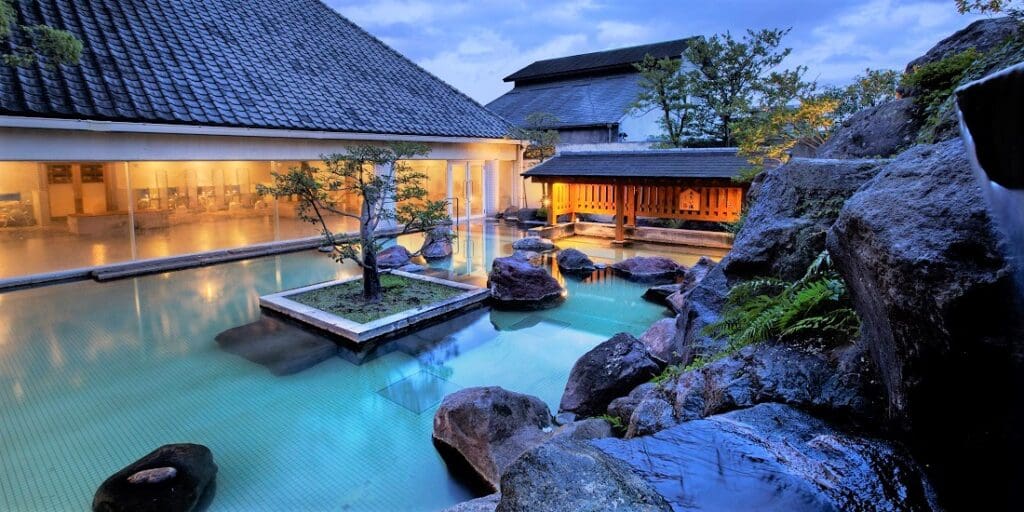
Every sauna culture develops its own protocol. Finland has the long, unhurried single-session format. Germany and Austria codify the Aufguss ceremony with a specific löyly pouring rhythm and towel waving sequence. Japan's contribution is totonou — a named physiological state reached by completing a precise heat-cold-rest cycle.
The sequence: 8 to 12 minutes in the sauna at 80–90°C (176–194°F), followed by 1–2 minutes submerged in a cold water bath (mizuburo) maintained at 15–17°C (59–62°F), followed by 10 minutes of quiet rest in an outdoor or ventilated space. The Japanese term for the cold bath — mizuburo — is as institutionally specific as löyly is in Finnish culture. The resting chair used in this recovery phase is called a totonoi chair, and reputable Japanese facilities stock them specifically for the purpose.
The "totonou" state is characterized by heightened sensory clarity, reduced anxiety, and physical relaxation — reached not by heat alone, but by the contrast between heat and cold followed by undisturbed rest.
The physiology behind this has been studied. The heat phase activates the hypothalamic-pituitary-adrenal axis, producing a controlled stress response that raises core body temperature. Cold immersion triggers rapid sympathetic activation followed by a pronounced parasympathetic rebound. The rest phase — when body temperature normalizes and the nervous system recalibrates — is when totonou is reported as most perceptible. A 2021 study published in Frontiers in Physiology documented significant reductions in salivary alpha-amylase (a marker of sympathetic nervous system activity) in participants who completed post-sauna cold water immersion versus those who used heat alone. Heart rate variability measurements taken during the rest phase showed clear parasympathetic dominance.
For a deeper look at the health benefits of sauna use — including cardiovascular, metabolic, and neurological outcomes — BW Sauna Co's research-backed overview covers the current clinical evidence in full. The Research Library compiles the primary studies for anyone who wants the source material.
Wabi-Sabi
Japanese Building Philosophy in Sauna Design
Japan's influence on sauna design is not cosmetic. Two centuries of Japanese timber-building tradition produce structural and material decisions that are meaningfully different from Scandinavian or Central European approaches.
Hinoki Cypress: Why Japan's Sauna Wood Isn't Cedar
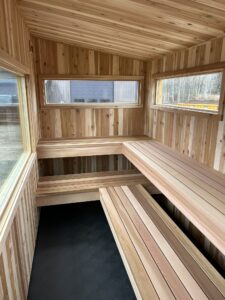
Western saunas default to Nordic spruce, thermally modified aspen, or Western red cedar. Japanese premium installations use hinoki (Japanese cypress, Chamaecyparis obtusa). Hinoki is prized for three functional properties: moisture resistance under repeated heat cycling, a tight grain structure that resists checking and splitting, and the natural aromatic oils it releases when heated.
Those oils are not incidental. Hinoki produces alpha-pinene and bornyl acetate — compounds that have been studied for therapeutic properties. A study published in the International Journal of Aromatherapy (2006) found that hinoki essential oil exposure reduced salivary cortisol levels in test subjects by 12 to 21%, a measurable acute stress reduction. Separate Japanese forestry research has documented the wood's antimicrobial activity, which means hinoki bench surfaces develop less bacterial load than untreated Western alternatives under the same conditions of use. This is not marketing language — it is a documented material characteristic that Japanese builders have worked with for centuries.
12–21% Reduction in salivary cortisol observed with hinoki essential oil exposure (International Journal of Aromatherapy, 2006)
Wabi-Sabi Aesthetics and the Sauna Room
Wabi-sabi — the Japanese philosophical acceptance of impermanence and imperfection in materials — produces a sauna interior that reads differently from a Finnish or German build. Unpainted surfaces. Natural grain variation kept visible rather than sanded away. Asymmetrical bench placement. Soft, non-directional lighting. The room is not designed to look new. It is designed to age well, developing a patina over years of use that Western designers typically try to prevent.
The practical consequence is a build that requires less chemical intervention and anticipates the reality of ongoing heat and humidity exposure rather than resisting it. A sauna room influenced by wabi-sabi aesthetics does not look neglected when it shows its age. It looks correct.
Shou Sugi Ban
The Art of Preserving Wood with Fire
The exterior surface of Japanese-influenced saunas carries the most visible marker of Japanese craft tradition. Shou sugi ban (焼杉板, yakisugi) is a wood preservation method that originated in Japan's Edo period — approximately the late 18th century. Carpenters working in a hot, humid climate with limited access to paint or chemical preservatives discovered that lightly charring the surface of sugi (Japanese cedar) made it resistant to moisture, insects, and decay. The process requires no additives. The charred surface carbon layer seals the wood grain while producing a micro-porous texture that has become a recognizable aesthetic marker in Japanese timber architecture.
Long before today's coated paints or preservers, Japanese builders learned that fire — rather than destroying wood — could preserve it. Charred boards became stout, blackened planks valued for their durability and low maintenance requirements.
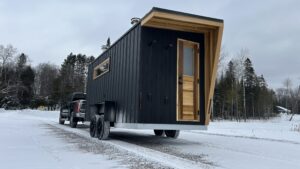
Applied to sauna exteriors, shou sugi ban produces a cladding material that resists the weathering that plain cedar or spruce would experience over years of outdoor exposure in freeze-thaw cycles, UV, and rain. Modern fabricators use controlled torch application followed by wire-brushing to remove loose carbon, with an optional oil finishing step. The technique has moved well beyond Japan — it is now used by sauna builders in North America and across Europe — but its origins are specifically Japanese, rooted in practical problem-solving in a challenging climate. That lineage is direct and documented.
Automated Steam
Unique to Japan: Auto-Löyly
Traditional Finnish sauna practice requires the bathers or an attendant to ladle water over hot stones at intervals — an active, participatory ritual. Japan adapted this into an automated format. In Japanese commercial facilities, electronically controlled pumps dispense precise volumes of water onto heated rocks at regular intervals, typically every 10 to 15 minutes, maintaining a consistent, low-level steam environment throughout the session.
This is not a shortcut — it is a calibration to the Japanese preference for quiet, passive, predictable bathing. Solo bathers receive the physiological benefit of steam exposure without needing to manage the process. The system can be augmented with fragrant additives: yuzu citrus, bamboo charcoal, locally sourced mineral water, or dried herbs. These compounds enter the steam and contribute additional therapeutic effects that align with Japan's formal research on sauna's cardiovascular and autonomic benefits. The Japan Society of Balneology, Climatology and Physical Medicine has published institutional guidelines that treat sauna as a clinical tool, specifying temperature ranges, session durations, and cooling intervals for patients with hypertension, chronic fatigue, and anxiety disorders — a level of formal recognition that does not yet exist in the United States.
Clinical Evidence
What the Research From Japan Actually Shows
Japan has produced independent sauna research that stands alongside Finnish longitudinal cohort studies as credible primary evidence. A 2018 study from researchers at Jichi Medical University, published in the Journal of Human Hypertension, found that repeated sauna bathing reduced systolic blood pressure by an average of 8 mmHg in participants with mild hypertension over a four-week protocol. That is a clinically significant reduction by accepted cardiovascular medicine standards.
–8 mmHg Avg. systolic blood pressure reduction after 4-week sauna protocol (Jichi Medical University, Journal of Human Hypertension, 2018)
Significant inverse Relationship between sauna use frequency and depression screening scores (Ehime University, 2020)
A 2020 retrospective study from Ehime University examined self-reported sauna use frequency against standardized depression screening scores and found a statistically significant inverse relationship — consistent with findings from Finnish cohort studies tracking nearly 2,300 men over 20 years. The mechanism is consistent: repeated heat exposure followed by parasympathetic recovery produces changes in beta-endorphin and norepinephrine activity that correlate with improved mood and reduced anxiety symptoms.
The Japan Society of Balneology, Climatology and Physical Medicine has formalized these findings into therapeutic guidelines. This institutional recognition of sauna as an adjunct clinical intervention — with recommended protocols for specific diagnoses — is more developed in Japan than in the United States or Canada. It positions the sauna as a medical tool with a prescribed use case, not a wellness amenity with vague benefits.
For a full review of how long to stay in a sauna and what the evidence says about session parameters, BW Sauna Co's guide covers optimal duration, temperature, and frequency for different health goals.
Minimalist Mobile Saunas
Saunas in Japan Today
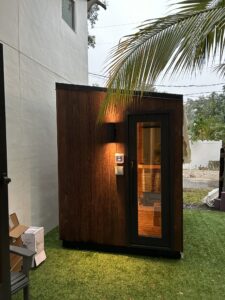
Contemporary Japanese sauna design reflects the spatial constraints of Tokyo, Osaka, and Nagoya. The trend toward compact, high-performance units — 2 to 4 person capacity, approximately 1.8m x 1.8m interior, precision temperature control, automated steam — is a direct product of urban density and real estate costs. Solo sauna units (ikkyaku format) have emerged as a concept unique to Japan, designed for a single occupant to complete the full totonou cycle in a controlled private environment.
This compact design imperative has produced engineering decisions that prioritize insulation efficiency, controlled heat retention, and maximum thermal performance from a minimal footprint. The goal is not fitting a standard sauna into a smaller space. It is rethinking what "performance" means at a smaller scale — which requires better materials, tighter construction tolerances, and more deliberate heating system selection.
These are the same engineering priorities that define a well-built mobile sauna. Maximum heat performance from a small, towable envelope is not a compromise — it is a design objective, and it demands the same attention to insulation, wood quality, and thermal efficiency that drives Japanese urban sauna construction.
Built in Duluth, MN
How These Principles Apply to What BW Builds
BW Sauna Co builds from Duluth, Minnesota — a climate that tests the same insulation and heat retention properties that Japanese engineers optimize for. The same principles that produce a high-performance compact sauna in a Tokyo building apply to a mobile trailer that needs to hold operating temperature efficiently in a northern Minnesota winter.
The wabi-sabi principle of designing for how materials actually behave over time — rather than how they look the day they ship — aligns with how BW selects wood species, bench profiles, and finish treatments. The shou sugi ban approach to exterior preservation is relevant for any outdoor unit that faces seasonal weather without the option of permanent shelter. And the totonou protocol — heat, cold, rest — is what a BW mobile sauna makes possible anywhere you can park and access water.
If you're in Minnesota or the Upper Midwest and exploring what a mobile sauna in Minneapolis looks like in practice — for a residential property, lake lot, retreat operation, or commercial use — BW builds units designed to perform at a level that holds up to the design standards Japan has codified over decades.
Ready to Explore BW's Mobile Sauna Lineup?
Built in Duluth. Designed for performance in real northern winters. Available for residential, commercial, and hospitality use across the Midwest.
See Mobile Saunas Saunas in Minneapolis, MN Continue the Series — A Journey Through Global Sauna Traditions