
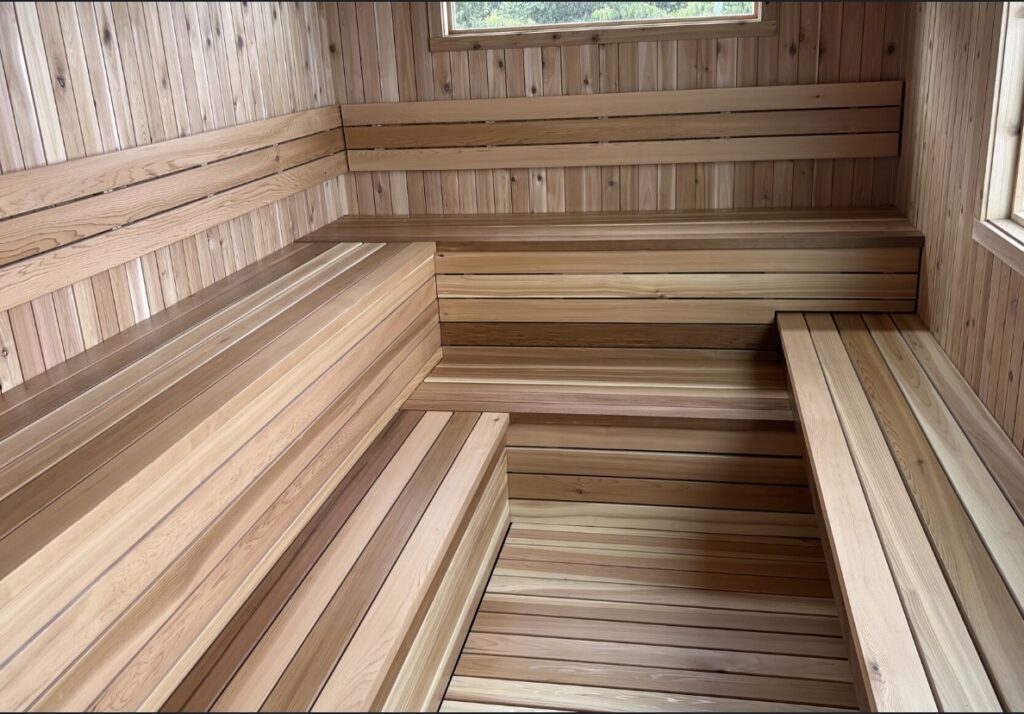
The wood on the inside of a sauna is not trim. It is a working material inside a small room that swings from cold to roughly 190 degrees and back, over and over, for decades. It absorbs and releases moisture. It moves. It touches bare skin. Cedar earns its place in that room for reasons that hold up under a microscope, not just to the eye. Here is the material science, and how it changes what goes on the wall and what goes on the bench.
Why cedar does not rot
Western red cedar resists decay because of its own chemistry, not a coating. The heartwood contains a group of natural compounds called thujaplicins, part of a family known as tropolones. These are fungitoxic. They stop the fungi that cause wood rot from taking hold, and they discourage insects at the same time. The wood builds its own preservative and carries it in the grain.
Cedar also holds very little water relative to its volume. It has a low density and an open, straight cell structure that sheds moisture quickly instead of trapping it. Rot needs sustained moisture and a food source the fungus can reach. Cedar denies it both. Dry cedar stays dry, and cedar that gets wet gives the water back fast.
This matters more inside a sauna than almost anywhere else in a building. A sauna is a moisture cycle by design. Steam goes up, condenses on cool surfaces, and the room dries out between uses. A wood that fights fungal growth on its own is doing quiet work every single session.
How cedar behaves under heat
Cedar is a low density softwood, and low density means low thermal conductivity. It is one of the least conductive commercial softwoods. In a sauna that produces two effects that both matter.
First, the wall itself is a modest insulator, so heat stays in the room instead of pouring into the surface. Second, and this is the part guests feel, the wood surface does not store and throw heat the way stone or metal does. You can lean a bare shoulder against a cedar wall at full temperature and it does not scald you. Put the same shoulder on a steel bracket at the same air temperature and you will move it fast. That is why fasteners inside a sauna get hidden and why bench and wall material is chosen for how it handles heat against skin.
Cedar is also low in resin. Pine and spruce carry pitch that softens and weeps at sauna temperature, leaving sticky spots and a burnt smell near the heater. Cedar has almost none of that, so it stays clean under repeated heat. The volatile that cedar does give off is an aromatic compound called cedrol, which is what you smell when the room comes up to temperature. It is the scent, not a resin problem.
Moisture, movement, and why drying comes first
Wood is hygroscopic. It takes on and gives up moisture until it reaches equilibrium with the air around it, and it changes size as it does. That number is the equilibrium moisture content, or EMC. A sauna drives the EMC around hard, so the wood has to be dry and stable before it ever goes on the wall.
Cedar that is installed green or damp will shrink as the room dries it out. Boards pull away from each other, gaps open, tongue and groove joints separate, and the wall looks tired within a season. The fix is not a better board. It is a properly dried and acclimated board.
- Cedar is kiln dried to a low, stable moisture content before it is worked.
- It is then acclimated to the space where it will live, so it is already near its service moisture content at install.
- Grain orientation is chosen with movement in mind. Vertical grain, or quarter sawn, moves less across its width than flat sawn and stays flatter through heat cycles.
- Boards are set with the small allowance for movement that the profile is designed for, so the wall can breathe without buckling or gapping.
The detail most people never hear about is acclimation. Wood that gets bought Monday and installed Monday afternoon in January has no chance to reach the moisture content it will live at. It dries and separates in the room. Cedar gets to sit and stabilize first. That single step is the difference between a wall that stays tight for years and one that opens up.
Cedar grades, and why benches are clear cedar
Cedar is sold by grade, and grade is mostly about knots. Clear cedar is cut to be free of knots and defects. Knotty cedar, often sold as select tight knot, keeps sound knots for a more rustic look. Both are real cedar with the same base chemistry. The difference is what the knots do under heat.
A knot is a hard, resin dense point where a branch met the trunk. It expands and contracts at a different rate than the surrounding wood. Run that through hundreds of heat cycles and knots can check, crack, and split open. On a wall that is a cosmetic issue you can live with. On a bench it is not, because a split at the surface is a place to pinch skin and a spot that traps water. That is why bench material should be clear cedar. The seat is the one surface that touches bare skin under load every session, and it needs to stay smooth and closed.
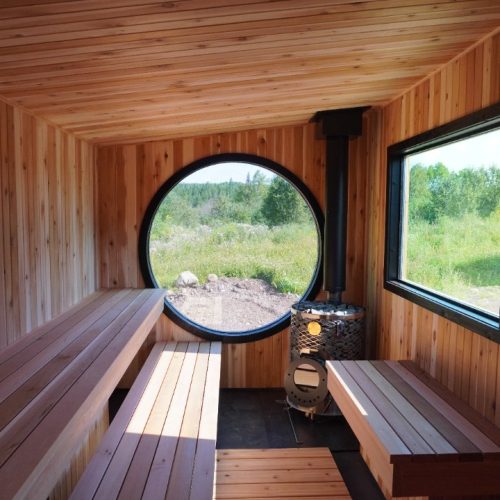
| Grade | Character | Best use in a sauna |
|---|---|---|
| Clear cedar | No knots, uniform surface, most stable | Benches and backrests. Any surface that touches skin. |
| Knotty / select tight knot | Sound knots, rustic character, lower cost | Walls and ceiling, where the look is wanted and knots stay sound. |
| Vertical grain | Quarter sawn, tightest movement | Anywhere dimensional stability matters most. |
How to read cedar when you buy it
Look at the grain direction first. Vertical grain lines running straight down the face move less than wide, arcing flat sawn figure. Check the ends and faces for pitch pockets and loose knots. Confirm it is heartwood, not the pale sapwood, because the decay resistance lives in the heartwood. And confirm the moisture content, because a good grade installed wet still fails.
Aspen, and where exotic woods fit
Cedar is the default for good reason, but it is not the only interior wood. The right choice depends on where it goes and what you want from it.
Aspen
Aspen is a pale, nearly white hardwood with no resin and no strong scent. It stays cooler to the touch than most woods and does not splinter easily, which makes it a strong bench and backrest material for anyone who wants a low aroma, low allergen room and a bright, clean look. Where cedar gives you scent and warmth of color, aspen gives you neutrality and a cooler seat.
Exotic and thermally modified woods
Woods like abachi and thermally modified species are used for their heat behavior and stability. Thermal modification bakes the wood to reduce its ability to take on moisture, which improves dimensional stability and darkens the color. Exotic species can offer distinct color and grain for a custom room. The trade is cost and sourcing, and the requirement never changes: whatever the species, it has to stay stable and stay safe against skin under heat.
Cutting, joining, and installing
Cedar is soft and easy to cut, which is exactly why it is easy to cut badly. Soft fibers tear out if the tooling is dull or the feed is wrong, and a torn edge shows.
- Use sharp carbide tooling. A clean, high tooth count blade leaves a smooth edge on soft cedar where a dull blade tears it.
- Keep the feed steady and let the tool do the cutting. Forcing soft cedar burns and fuzzes the edge instead of slicing it.
- Cut with dust protection. Cedar dust is a known respiratory irritant because of a compound called plicatic acid, and it should not be breathed. This is a shop concern, not a finished sauna concern.
Joinery that survives heat cycling
Joints inside a sauna have to move without failing. Tongue and groove and shiplap profiles let boards expand and contract while staying visually tight, which is why they are the standard for sauna walls and ceilings. Mechanical connections and hidden fasteners hold up. Glue joints are the weak point, because the same heat and moisture that the room throws at the wood also work on adhesives over time. The design goal is a wall that is allowed to move a little, not one clamped rigid.
Fasteners are kept hidden and away from skin surfaces. Exposed metal in a sauna gets hot enough to burn, so screws and brackets sit behind the wood, not in front of it.
Finish, sunlight, and how cedar changes color
The most common mistake with sauna wood is sealing it. A film finish, a varnish or a polyurethane, traps moisture against the wood, gets hot, and can off gas. Interior sauna cedar is left bare or treated only with a sauna safe paraffin oil, and the oil is used mainly on benches, where it keeps the surface clean and easy to wipe down. Walls are usually left raw so the wood can keep breathing and doing its moisture work.
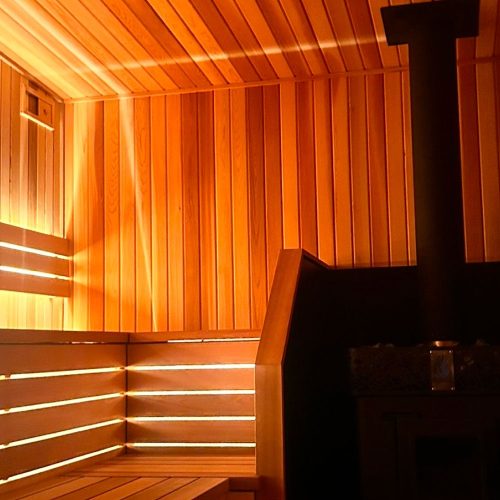
Cedar changes color with light and time. Ultraviolet light breaks down the surface lignin and drives the well known silvering you see on exterior cedar. Inside a sauna, out of direct sun, that silvering is not the story. What you see indoors is a slow warming and deepening of the tone as the wood ages, which most owners want. If a piece of cedar sits in a sunlit window, it will lighten and gray on that face, which is a placement decision more than a finish decision.
Maintenance that keeps cedar for decades
Bare cedar in a well built sauna asks for very little. The room does most of the work by drying out between uses.
- Let the sauna air out and dry fully after each session. A room that dries has no rot problem.
- Wipe benches down and re oil clear cedar benches with a sauna safe oil when the surface stops shedding water.
- Leave the walls bare. Do not seal, stain, or varnish interior cedar.
- Sand out any raised grain or rough spot lightly rather than coating over it.
More on care over time lives in our guide on outdoor sauna maintenance. If you are still choosing a heat source, the material behavior above pairs with the tradeoffs in electric or wood burning stove.
Cedar in a sauna, answered
Why is cedar used for saunas instead of a cheaper wood?
Cedar combines four traits that a sauna needs at once. It resists rot through natural compounds in its heartwood, it has low thermal conductivity so it insulates and stays touchable at high heat, it carries almost no resin so it will not weep or burn near the heater, and it is dimensionally stable when properly dried. Cheaper softwoods like pine and spruce carry pitch that softens and leaves sticky, burnt spots at sauna temperature.
Should sauna benches be clear cedar or knotty cedar?
Benches should be clear cedar. Knots are hard, resin dense points that expand and contract differently than the surrounding wood, so over many heat cycles they can crack and split open. On a bench, a split surface can pinch skin and trap water. Knotty cedar is fine for walls and ceilings, where the look is wanted and the knots stay sound.
Does cedar rot in a sauna?
Properly dried cedar in a sauna that dries out between uses does not rot. Cedar heartwood contains thujaplicins, natural compounds that are toxic to the fungi that cause decay, and cedar takes on little water and releases it quickly. Rot needs sustained moisture, and a sauna that airs out between sessions never gives it that.
Do you seal or stain cedar inside a sauna?
No. Film finishes like varnish and polyurethane trap moisture against the wood, get hot, and can off gas. Interior cedar is left bare, or benches are treated with a sauna safe paraffin oil. Walls are usually left raw so the wood can keep releasing moisture.
Why does cedar need to be dried and acclimated before installation?
Wood changes size as it gains and loses moisture. Cedar installed damp will shrink as the sauna dries it out, opening gaps and separating joints within a season. Cedar is kiln dried to a low moisture content and then acclimated to the space so it is already near its service moisture level at install, which keeps the wall tight for years.
What is the difference between cedar and aspen for a sauna interior?
Cedar is warm in color, aromatic, rot resistant, and insulating. Aspen is pale and nearly white, has no resin and almost no scent, stays cooler to the touch, and does not splinter easily, which makes it a strong choice for benches and for anyone who wants a low aroma, low allergen room. Many builds use both.
Chan-Yeung, M. (1994). Occupational asthma from western red cedar and the role of plicatic acid.
Dayawansa, S. et al. (2003) and Sano, A. et al. (2007) on cedrol, the aromatic compound released by cedar under heat.
Western red cedar heartwood durability and thujaplicin chemistry are documented across forestry and wood science literature on naturally durable softwoods.