

Sauna in Austria and Germany: The Aufguss, the Saunameister, and Heat as Performance
Germany and Austria took the Finnish sauna and turned it into an institution. Certified sauna masters, choreographed steam rituals, spa towns with two thousand years of history, and glass-walled hot rooms hanging over Alpine valleys. This stop on our global sauna traditions series covers the two countries that professionalized the sweat bath, and what their standards say about building saunas well.
German and Austrian Sauna Facts
- Scale: Industry data citing the German Sauna Association and DEHOGA puts sauna use in Germany at over 30 million people per year.
- The institution: The Deutscher Sauna-Bund, founded in 1949, certifies sauna masters and sets facility standards nationwide.
- The ritual: The Aufguss. A Saunameister pours water and essential oils over hot stones, then drives the steam through the room with choreographed towel work.
- The competition: Aufguss has a world championship. The Aufguss WM judges sauna masters from dozens of countries on heat management, towel technique, and fragrance.
- The history: Baden-Baden's Friedrichsbad, opened in 1877, was built directly on the site of Roman thermal baths. The town joined the UNESCO World Heritage List in 2021.
- The rule: German and Austrian sauna areas are textile-free. Swimsuits are prohibited for hygiene, and large towels cover every bench surface.
The Door Closes, the Saunameister Begins
It is 4 p.m. at a Therme outside Munich. A schedule board by the sauna door lists the day's Aufguss sessions the way a theater lists showtimes: alpine herbs at noon, citrus at two, birch tar at four. A few minutes before the hour, people file in and spread their towels on the benches. The room fills. Then the Saunameister enters with a bucket, a ladle, and a rolled towel over one shoulder, and closes the door.
What follows runs 10 to 15 minutes. Water infused with essential oils goes onto the stones in measured pours. The Saunameister works the towel in wide arcs, snapping waves of superheated air across the benches. Each round of pouring and waving pushes the felt heat higher. Nobody talks. Nobody leaves, because opening the door mid-ritual dumps the heat and breaks the room. When it ends, everyone walks out to the cold plunge and the quiet rooms, and the schedule board points to the next session.
This is the Aufguss, and it is the signature of German-speaking sauna culture. The word translates loosely as "infusion." In practice it is löyly turned into performance, with enough technique behind it that the Aufguss WM crowns world champions on heat distribution, towel work, fragrance dosage, and theme. A jury scores each ritual out of 100 points.
Two Thousand Years of Heat, One Town at a Time
The German-speaking world came to sweat bathing through the Romans. Legions garrisoned along the Rhine and Danube built thermal baths wherever hot springs surfaced, and the towns that grew around those springs never stopped bathing. Baden-Baden is the clearest example. The Romans built thermal baths on the Florentinerberg hill, and eighteen centuries later the town constructed the Friedrichsbad on the same site. Opened in 1877 and modeled on the Baths of Caracalla in Rome, it was considered the most modern bathhouse in Europe at the time. It still runs its full Roman-Irish bathing circuit today, and in 2021 Baden-Baden was inscribed on the UNESCO World Heritage List as one of the Great Spa Towns of Europe.
Medieval bathhouses carried the habit through the centuries between, and the 19th-century Lebensreform movement, with its focus on natural health, fresh air, and hydrotherapy, made structured bathing part of the German health regimen. Bad Wörishofen, home of the Kneipp water cure, dates to the same era. The Finnish sauna itself arrived in force in the 20th century, and in 1949 the Deutscher Sauna-Bund was founded to promote it, standardize it, and train the people who run it. That is the same institutional instinct that gave the world certified Saunameisters and scheduled Aufguss programs.
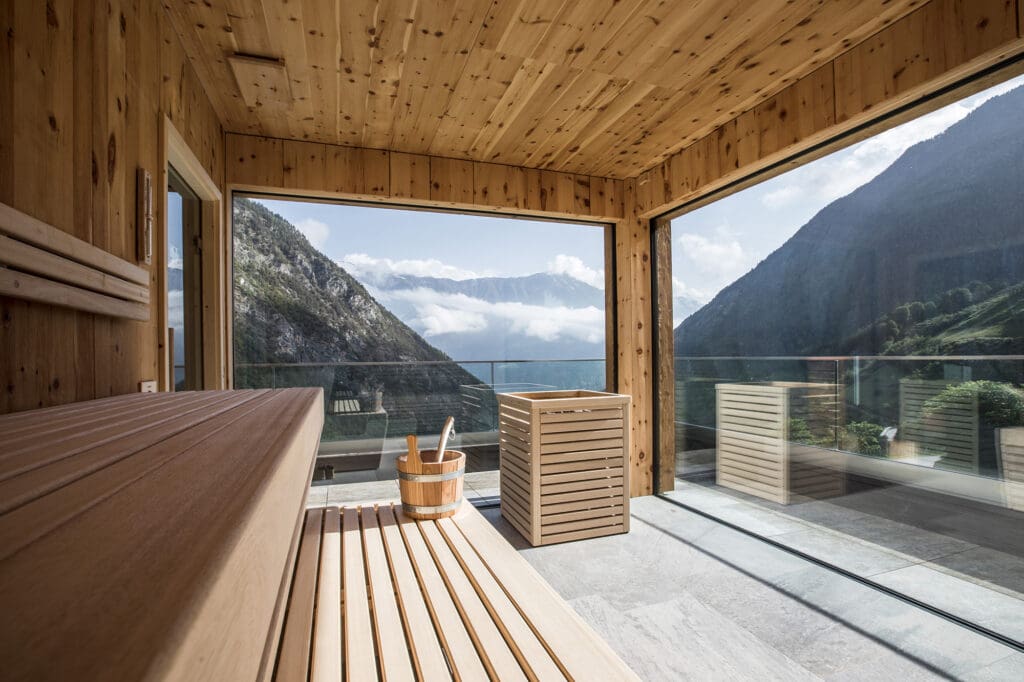
Austria layered the same culture onto the Alps. Thermal spring towns like Baden bei Wien carry the Roman lineage, while modern resorts such as Aqua Dome in Tirol build panorama saunas with floor-to-ceiling glass facing the peaks. In ski country, the sauna is the standard end to a day on the mountain. Heat after exertion is treated as recovery, not luxury.
The Rules Are the Point
Visitors are often surprised by how regulated a German sauna feels. Swimsuits are banned in the sauna area, full stop. The logic is hygiene: fabric traps sweat against wood, so bathers sit on large towels with no skin touching the bench. Showers before entry are mandatory. Quiet is enforced in rest areas. Leaving during an Aufguss is bad form.
Strip the etiquette down and every rule protects one of two things: the wood or the heat. That mindset transfers directly to how a sauna should be built. Protect the wood and manage the heat, and a hot room lasts decades. It is the same reason our builds put so much into the wall assembly itself. Our post on the heat layers of a trailer sauna walks through the eight-layer system we use, from the cedar or aspen interior through the foil vapor barrier, rock wool insulation, and corrugated metal exterior. German sauna culture polices heat loss with etiquette. We build it out with insulation.

What the Research Says
The German medical establishment treated sauna as preventive health long before the current research wave, and the data has largely backed the instinct. A 2018 review by Laukkanen and Kunutsor in Mayo Clinic Proceedings examined the evidence on sauna bathing and found it linked to reduced risk of cardiovascular outcomes, with benefits increasing alongside frequency of use. A separate systematic review by Hussain and Cohen in Evidence-Based Complementary and Alternative Medicine reached similar conclusions across the clinical literature on regular dry sauna use. The full research breakdown lives on our sauna health benefits page.
The German session structure is worth copying regardless of where your sauna sits: shower, 8 to 15 minutes of heat, cold water, then a genuine rest before the next round. Two or three rounds total. It is the same rhythm we lay out in our post on how to use a traditional Finnish sauna.
The Panorama Sauna and the Case for Glass
Austria's contribution to sauna design is the view. Alpine resorts figured out that a wall of glass turns a hot room into an observation deck, and the panorama sauna became a fixture of mountain spas. The engineering problem is obvious: glass is the weakest thermal link in any hot room, and a bad window turns a 190-degree sauna into a struggling one.
We build for the same views on this side of the Atlantic. Lake Superior through a picture window beats a blank wall every time. Our answer to the thermal problem is double-pane glass as standard on every build, with triple-pane available for cold climates and window-heavy designs. Pair that with a proper stove from IKI, Kuuma, or Harvia and the room holds its heat with the mountains, or the lake, in full view. The choice between wood fire and electric heat has its own tradeoffs, which we cover in our post on electric versus wood-burning sauna stoves.
Saunas in Germany and Austria Today
Sauna in the German-speaking world is mainstream infrastructure. Industry data citing the German Sauna Association and DEHOGA counts over 30 million Germans visiting a sauna at least once per year, spread across municipal pools, hotel spas, fitness clubs, and large standalone Saunalandschaften with a dozen themed rooms under one roof. Private home saunas are a growing share of the market. Austria runs the same way at Alpine density, with thermal resorts anchoring entire town economies.
The takeaway for American owners and operators is the business model. Germany and Austria proved that heat, done to a standard, is a destination people pay for on a schedule. That is exactly the pattern behind our commercial sauna builds for resorts, retreats, and rental operators, and behind every custom sauna we deliver to a private home. Roughly 50-plus mobile saunas out of our Duluth shop say the demand travels well.
Build Your Own Alpine Standard
We build custom traditional saunas in Duluth, Minnesota and deliver across the continental United States. Wood-fired or electric, panorama windows included. Explore our mobile saunas for sale, our custom home saunas, or price a build with the custom sauna quote tool.
Talk Saunas With UsGerman and Austrian Sauna FAQ
What is an Aufguss?
An Aufguss is the signature German sauna ritual. A trained sauna attendant called a Saunameister pours water mixed with essential oils over the hot stones, then uses choreographed towel movements to drive waves of steam and heat across the room. A session typically runs 10 to 15 minutes, and etiquette calls for staying until it ends so the door stays closed and the heat stays in.
What is a Saunameister?
A Saunameister is a sauna master: the attendant who runs Aufguss rituals and manages the hot room. In Germany, the Deutscher Sauna-Bund, founded in 1949, certifies sauna masters and sets facility standards. The craft is competitive enough that an annual world championship, the Aufguss WM, judges sauna masters on heat management, towel technique, fragrance dosage, and theme.
Why are German saunas textile-free?
Hygiene. Swimsuits trap sweat and moisture against the wood, so German and Austrian sauna areas prohibit them. Bathers sit and lie on large towels so no skin touches the benches. Combined with mandatory showers before entry, the rules keep the wood clean and the room sanitary.
How many people use saunas in Germany?
Industry data citing the German Sauna Association (Deutscher Sauna-Bund) and the German hospitality association DEHOGA puts the figure at over 30 million Germans visiting a sauna at least once per year, across municipal pools, hotel spas, fitness clubs, and dedicated sauna complexes.
How is German sauna culture different from Finnish sauna culture?
The heat is the same; the format differs. Finnish culture centers on small private and family saunas where bathers control their own löyly. German culture centers on large public facilities with scheduled, staff-led Aufguss rituals, strict etiquette, and certified sauna masters. Finland made the sauna domestic. Germany made it institutional.
Can you build a German or Austrian style sauna in the United States?
Yes. BW Sauna Co. builds custom traditional saunas in Duluth, Minnesota and delivers nationwide. Builds use cedar or aspen interiors, IKI, Kuuma, or Harvia stoves capable of full Aufguss-style löyly, and panorama windows with double-pane glass standard and triple-pane available. Custom builds start around $40,000 to $60,000 and up, and larger commercial builds are available for resorts and hospitality operators.