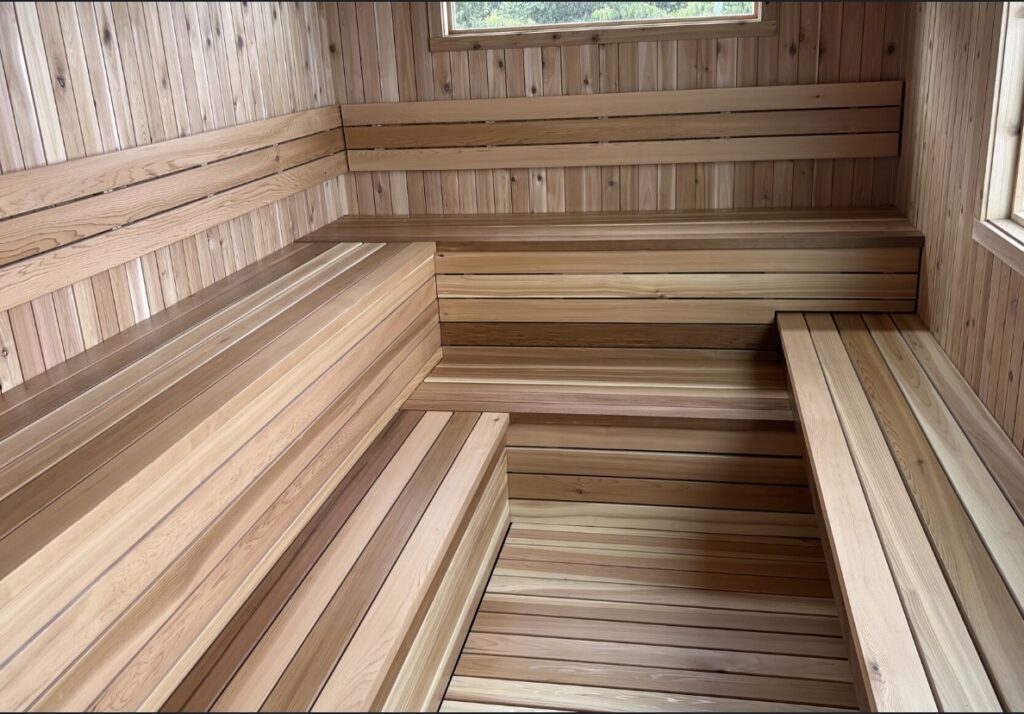
What cedar does in a sauna.
A deep look at the compounds, the thermal physics, and the woods that share cedar’s chemistry, including the ones most people have never heard of.
By BW Sauna Co. · Materials & Construction
Sit on a cedar bench at 180°F and nothing happens. The wood is the same temperature as the air around it, and yet your skin doesn’t react. Pour water on the rocks, the room jumps another twenty degrees, and the bench stays comfortable. This is not an accident. It is a property of the material, and it is a much larger story than most people building a sauna realize.
The reason cedar became the standard for sauna construction in North America is partly tradition, partly aesthetics, and almost entirely chemistry. The wood contains a small library of compounds that other softwoods do not, and those compounds do specific, measurable things inside the heat. Understanding what they are, and what other woods share them, is the difference between picking a material because it looks right and picking one because it works.
This piece goes through the actual science. Cited where claims come from peer-reviewed work. Honest where the trade-offs are real. It is the deep dive that anyone specifying a custom sauna, or just curious about why their wood feels different in the heat, deserves to read.
Why wood at all.
Before we get to cedar specifically, there is a more basic question. A sauna at full operating temperature sits between 160°F and 200°F, with brief peaks well above that when water hits the rocks. At those temperatures, most materials would burn skin on contact. Steel benches would be unusable. Aluminum would be worse. Concrete would store enough thermal mass to remain dangerous after the room cooled.
Wood is the only common interior material that handles those temperatures without injuring the people sitting on it. The reason is its thermal conductivity, the rate at which heat moves through the material into something touching it.
Thermal conductivity at room temperature
| Aluminum | 1,500 |
| Steel | 310 |
| Glass | 7 |
| Concrete | 6 |
| Plaster | 5 |
| Structural softwood (12% MC) | 0.7–1.0 |
| Western red cedar (12% MC) | 0.74 |
| Mineral wool insulation | 0.25 |
Values in BTU·in / (h · ft² · °F). Compiled from the American Wood Council and the USDA Forest Products Laboratory Wood Handbook.
Steel conducts heat roughly 420 times faster than western red cedar. That is the difference between an instant burn and a comfortable contact. The reason is structural. Wood is mostly air. The cell-cavity architecture of softwoods traps air in vast numbers of small pockets, and dry air is one of the best insulators in nature. The denser the wood, the more solid material it contains and the better it conducts heat. Cedar happens to be one of the lightest commercial softwoods in North America, with an oven-dry density around 22 pounds per cubic foot and a specific gravity of about 0.35. The Western Red Cedar Lumber Association notes that this density makes it the best thermal insulator among commonly available softwoods.
This is also why cedar feels warm. The wood pulls heat from your skin so slowly that the surface temperature you perceive stays close to your body’s. A denser hardwood at the same air temperature would feel colder, not because it is colder, but because it is moving heat away from your hand faster.
So that is the first answer. Wood is the right material because it conducts heat slowly enough to be safe at sauna temperatures. But this is true of most softwoods, not just cedar. The question gets more interesting from here.
Why cedar specifically.
Aspen handles heat. Spruce handles heat. Hemlock and basswood and pine all sit comfortably in a sauna at 180°F. So if thermal conductivity were the whole story, any of those would be acceptable. What distinguishes cedar is what happens on the chemistry side.
Wood is structurally cellulose and lignin, with a small fraction called extractives. Extractives are the secondary metabolites a tree produces to defend its heartwood against decay, insects, and microbial colonization. In most softwoods, extractives are modest. In western red cedar (Thuja plicata), they are extraordinary. The heartwood contains higher concentrations of aromatic and polyphenolic extractives than other commercially relevant softwoods, and several of those compounds have measurable biological activity.
The heartwood of cedar is doing chemistry that other woods are not. That is the difference.
The compounds that matter most are the thujaplicins, the sesquiterpene cedrol, and the tropolone family they belong to. Each one does something specific. We will take them one at a time.
Thujaplicins: the antimicrobial defense.
Thujaplicins were first isolated from the heartwood of Thuja plicata in the 1930s by chemists trying to understand why cedar resisted decay where neighboring softwoods did not. Three were identified, named α-, β-, and γ-thujaplicin. They are tropolones, seven-membered aromatic rings, and they were the first non-benzenoid aromatic compounds ever characterized.
The β isomer is the most studied. It has a second name that comes from where it was first independently isolated, in a Japanese cypress: hinokitiol. Both names refer to the same molecule.
β-thujaplicin (hinokitiol)
C₁₀H₁₂O₂ · Tropolone class
Antibacterial against Gram-positive and Gram-negative bacteria. Antifungal against decay fungi, Aspergillus, and Candida species. Antiviral activity demonstrated against influenza in copper-chelate form. The mechanism is iron-binding chelation: the compound binds metal ions that microbes need to function, and they cannot grow.
In Japan, hinokitiol is approved for the treatment of oral candidiasis. It is added to toothpastes, mouthwashes, and antimicrobial textile finishes. The same compound is sitting in the heartwood of every clear cedar board.
The peer-reviewed evidence on this is substantial. Trust and Coombs demonstrated the antibacterial activity of β-thujaplicin in 1973. Inamori and colleagues published a series of studies through the late 1990s and early 2000s expanding the documented antimicrobial range. A 2011 paper from the University of British Columbia tested cedar leaf oil (extracted from the foliage of Thuja plicata) against a panel of human bacterial and fungal pathogens, finding all of them susceptible to both the liquid and the vapor phase of the oil, with no toxicity to cultured human lung cells over 60 minutes of exposure. A 2021 study placed hinoki cypress wood in two rooms of the Owase City Hall in Japan and tracked bacterial colony growth: the control room without cypress showed bacterial colonies after three days; the room with cypress wood took thirteen days for the same colonies to appear.
The implication for a sauna is direct. The environment is hot, humid, and used by bare skin. Microbial growth is exactly what you would expect to develop on the wood surfaces. The reason it does not, or does so much more slowly than it would on a chemically inert material, is that the wood itself is doing the antimicrobial work.
One more detail matters: thujaplicin concentration is not constant. Nault, in a 1988 study in Wood Science and Technology, found that the radial distribution of thujaplicins in cedar trunks rises from the pith outward into the heartwood, peaks near the outer heartwood, and then drops sharply in the sapwood. Older trees contain higher concentrations than younger ones. This is part of why old-growth cedar lumber commands a premium for exterior and high-durability applications: there is more active chemistry per board foot. It is also why heartwood cedar grades, not sapwood, are what belong inside a sauna where the wood is going to spend its life resisting moisture and microbes.
Cedrol: the parasympathetic compound.
The second compound is less talked about and arguably more interesting. Cedrol is a sesquiterpene alcohol present in the wood and essential oil of multiple cedar species. It vaporizes at moderate temperatures. In a hot environment, like the inside of a sauna, cedrol leaves the wood and enters the air. You inhale it.
In 2003, a research group in Japan led by Dayawansa published a study in Autonomic Neuroscience in which 26 healthy human subjects inhaled vaporized cedrol through a face mask while their heart rate, blood pressure, respiratory rate, and heart rate variability were monitored. Exposure to cedrol significantly decreased heart rate, decreased both systolic and diastolic blood pressure, decreased respiratory rate, and increased baroreceptor sensitivity. Spectral analysis of heart rate variability indicated that the high-frequency component, which reflects parasympathetic activity, rose, while the low-frequency to high-frequency ratio fell. The autonomic nervous system shifted toward parasympathetic dominance. Cedrol, in plain terms, made people more relaxed in a way that was measurable on instruments, not just self-reported.
The finding has been replicated. A follow-up study by Sano and colleagues in 2007 examined women in their 20s, 30s, and 40s in Norway, Thailand, and Japan, measuring pupillary light reflex (a different proxy for parasympathetic tone). The cedrol-induced miosis rate increased significantly in all three populations, suggesting the sedative effect was not culturally specific. Animal models have shown that cedar wood essence exposure increases non-rapid-eye-movement sleep duration in rats and decreases NREM sleep latency in humans. A 2012 SPECT imaging study in laryngectomized human subjects (who could inhale cedrol directly into the lower airway without it passing through the nose) showed bilaterally increased hippocampal regional cerebral blood flow during cedrol inhalation.
Cedrol
C₁₅H₂₆O · Sesquiterpene alcohol
Present in western red cedar, Atlas cedar, Texas cedar (eastern red cedar / Juniperus virginiana), and several other species. Volatilizes at moderate temperatures. Inhalation produces measurable shifts toward parasympathetic dominance in human autonomic nervous system function.
This is not a placebo effect. The studies use objective measures: heart rate variability, pupillary response, regional cerebral blood flow. The compound has a real physiological mechanism.
The sauna, in other words, is doing more than heating you. The heat is volatilizing a sedative-acting compound out of the wood and into the air. This may be part of why a cedar sauna feels qualitatively different from a sauna lined with a chemically inert wood, even at the same temperature and humidity. The wood is contributing its own pharmacology to the experience.
None of this means the effects are large, and none of it means cedar is medicine. The compound’s clinical applications are still being studied. What it does mean is that the practice of sitting in a heated cedar room has a chemical layer underneath the cultural one, and the chemical layer has been validated in peer-reviewed work.
The honest trade-off.
The same wood that produces these compounds also produces another one. Plicatic acid is a low-molecular-weight phenolic compound unique to Thuja plicata heartwood, with smaller amounts in eastern white cedar (Thuja occidentalis) and Japanese cedar (Cryptomeria japonica). It is the cause of what occupational medicine calls western red cedar asthma, a real condition that affects 4 to 13.5 percent of sawmill workers chronically exposed to cedar dust in the Pacific Northwest.
What this actually means.
The mechanism, characterized by Chan-Yeung and colleagues in landmark studies from 1973 through 1994, is not classical IgE-mediated allergy. It involves direct histamine release from basophils and probable T-cell involvement. The exposure scenario that produces it is chronic inhalation of fine cedar dust over months to years in a milling or shaping environment.
This is not the same exposure scenario as a finished, kiln-dried cedar sauna interior. Installed cedar cladding releases volatile terpenes and trace amounts of extractives into the air, but it does not produce respirable dust. The two situations are biologically very different. Most cedar sauna users are unaffected. A small subset of people, particularly those with cedar dust sensitization or strong aromatic sensitivities, do react to installed cedar and prefer an alternative wood.
An honest specifier acknowledges this rather than pretending it isn’t there. The right answer for a sensitive client is not cedar. There are good alternatives. We will get to them.
Other woods that share cedar’s chemistry.
Western red cedar is not the only wood that produces thujaplicins and related antimicrobial tropolones. It is the most commercially available species with this chemistry in North America, which is why it became the regional standard. Elsewhere in the world, other species play the same role.
Hinoki cypress
Chamaecyparis obtusa
The Japanese cypress where hinokitiol (β-thujaplicin) was first independently isolated in 1936. Used for over 1,300 years in Japanese temple, shrine, and traditional bath construction, including Ise Grand Shrine. Chemically nearly identical antimicrobial profile to western red cedar, without plicatic acid. Significantly more expensive in North American markets, but used in high-end sauna and ofuro builds where the chemistry and aesthetic justify the import.
Alaska yellow cedar
Cupressus nootkatensis
Not a true cedar, despite the name. Native to the Pacific Northwest coast from Oregon north into Alaska. Contains tropolone-family compounds and is famously decay-resistant: standing dead Alaska yellow cedars have been documented surviving more than a century in the rainforest without rotting. Heavier and harder than western red cedar, with a distinct pungent aroma. Used in select premium sauna builds.
Aomori hiba
Thujopsis dolabrata
A Japanese conifer with one of the highest known hinokitiol concentrations of any wood species. Native to the Aomori region of northern Japan and to Hokkaido. Traditionally used for temple construction and high-grade interior carpentry. Difficult to source outside Japan and East Asia.
Incense cedar
Calocedrus decurrens
Native to the western United States. Contains hinokitiol along with other tropolones. Mostly known as the wood used for high-quality pencils, where its straight grain and easy sharpening matter, but it has been used for exterior cladding and small-scale sauna interior work.
True cedars
Cedrus libani, Cedrus atlantica, Cedrus deodara
The actual Cedrus genus from the Mediterranean and Himalayan regions. Confusingly, most “cedars” used in North American construction are not in this genus. Cedars of Lebanon and Atlas cedar are aromatic and cedrol-rich but their chemistry is different from western red cedar. Rarely used in sauna construction because availability and price make them impractical.
A useful clarification: in North American lumber, the word “cedar” is applied loosely to any aromatic, decay-resistant softwood with reddish heartwood. Most of them, including western red cedar and Alaska yellow cedar, are in the cypress family (Cupressaceae), not the genus Cedrus. The chemistry is the actual connection between them, not the name.
Woods that work without the chemistry.
The other approach is to use a wood that lacks cedar’s chemistry but offers a different set of advantages. For people sensitive to cedar, for sauna users who want minimal aroma, and for builders working in traditional Finnish style, these are the standard choices.
Aspen
European aspen (Populus tremula) and quaking aspen (Populus tremuloides) have essentially no resin, no aromatic oils, and a very low odor. The wood is hypoallergenic in practice. Density is low, around 26 pounds per cubic foot, so thermal conductivity is comparable to cedar’s. The surface is fine-grained and resists splintering, which makes it well-suited to bench tops and backrests where bare skin makes contact. Color is pale, nearly white, and the visual effect is bright and clean. Aspen has been used in Finnish saunas for centuries. It works because it stays out of the way: it is comfortable, neutral, and reliable. It does not do the antimicrobial work that cedar does, so the design has to compensate through air movement and surface drying.
Basswood
American basswood (Tilia americana) and European linden share most of aspen’s profile. Very low Janka hardness, very fine grain, almost no resin, almost no scent. Common in infrared sauna interiors specifically because users sit on the wood for 30 to 45 minute sessions and the surface temperature stays comfortable longer than denser woods. Basswood is the choice for people who want as close to chemically neutral as wood gets.
Spruce and pine, the Finnish tradition
The original sauna woods were spruce (Picea abies) and pine (Pinus sylvestris), used because they were the dominant softwoods growing within walking distance of Finnish farms. They are heavier than cedar and have higher resin content, which historically meant occasional sap bleed at high temperatures, but they perform well and are deeply rooted in the cultural tradition. Most contemporary Finnish saunas use spruce or pine paneling, often kiln-dried to low moisture content to minimize resin issues. The chemistry is different from cedar’s. No thujaplicins. Some monoterpenes (α-pinene most notably) that have their own modest phytoncide effects. They work, but the wood is not contributing the same active chemistry to the room.
Thermally modified wood
This is the modern category. Thermowood is a process originating in Finland in the 1990s in which softwood is heated to between 180°C and 230°C in a low-oxygen environment with steam. The chemistry of the wood is fundamentally changed. Hemicelluloses, which absorb water, are partially degraded. Lignins crosslink. Equilibrium moisture content drops from typical values of 8 to 12 percent down to 4 to 6 percent. The result is a wood that is dimensionally stable, decay-resistant through a completely different mechanism than cedar’s, and visibly darker. Thermally modified ash, pine, and aspen are now widely specified for sauna interiors and exteriors. The extractive chemistry that cedar relies on is partially destroyed in the process, so thermally modified woods do not contribute thujaplicins or cedrol, but they gain stability and durability that the untreated species lack.
What this means for a build.
The choice of interior cladding for a sauna is not just an aesthetic decision. It is a decision about chemistry. Knowing this changes how the question gets asked.
For most clients in most contexts, cedar (either knotty or clear, depending on the visual goal) is the appropriate default. The chemistry is doing real work. The thujaplicins are resisting microbial colonization in a hot, humid environment that would otherwise be a breeding ground for it. The cedrol vaporizing into the air is contributing a small but measurable parasympathetic effect that aligns with what users come to a sauna to find. The cost of clear-heart cedar over a generic softwood is mostly the cost of access to that chemistry.
For sensitive clients, aspen is the right answer. The wood is hypoallergenic, comfortable, and produces a bright, neutral interior that holds up over decades. It does not bring cedar’s active chemistry, but design and ventilation can compensate, and the trade-off is the right one for that user.
For clients building in a Finnish-traditional aesthetic or working with European suppliers, spruce or thermally modified aspen is culturally appropriate and structurally sound.
None of these choices is wrong. They are different answers to slightly different questions, and the science is what lets a specifier give the right answer for a given project. At BW Sauna Co., the standard interior options are knotty cedar, clear cedar, aspen, and select exotic species, with the conversation about which one is right for a given client happening early in the design process. There is a chemistry reason behind each option.
The takeaway is simpler than it sounds: the wood matters because the chemistry matters, and cedar has more of it than almost anything else commercially available. That is why one tree species, over more than a century of trial-and-error sauna construction in North America, has stayed at the center of the practice. Not because it was easy to source. Because it was doing chemistry the alternatives were not.
For more on how cedar fits into the rest of a well-built sauna, see our pieces on the heat layers of a trailer sauna, outdoor sauna lifespan, and the wood-burning Minnesota tradition. For broader context on sauna construction and the BW approach, see our custom home saunas and custom mobile saunas overview pages.
References and further reading.
- Anderson, A. B., and Gripenberg, J. (1948). Antibiotic substances from the heartwood of Thuja plicata D. Don. IV. The constitution of thujaplicin. Acta Chemica Scandinavica, 2, 644–650.
- Chan-Yeung, M. (1994). Mechanism of occupational asthma due to western red cedar (Thuja plicata). American Journal of Industrial Medicine, 25(1), 13–18. PubMed 8116639.
- Chedgy, R. J., Daniels, C. R., Kadla, J., and Breuil, C. (2007). Screening fungi tolerant to Western red cedar (Thuja plicata Donn) extractives. Part 2: Development of a feeder strip assay. Holzforschung, 61(2), 161–168.
- Dayawansa, S., Umeno, K., Takakura, H., Hori, E., Tabuchi, E., Nagashima, Y., Oosu, H., Yada, Y., Suzuki, T., Ono, T., and Nishijo, H. (2003). Autonomic responses during inhalation of natural fragrance of “Cedrol” in humans. Autonomic Neuroscience: Basic and Clinical, 108(1–2), 79–86. ScienceDirect.
- Hori, E., Shojaku, H., Watanabe, N., Kawasaki, Y., Suzuki, M., de Araujo, M. F. P., Nagashima, Y., Yada, Y., Ono, T., and Nishijo, H. (2012). Effects of direct cedrol inhalation into the lower airway on brain hemodynamics in totally laryngectomized subjects. Autonomic Neuroscience, 168(1–2), 88–92. ScienceDirect.
- Hudson, J. B., Sharma, M., and Petric, M. (2011). The Antimicrobial Properties of Cedar Leaf (Thuja plicata) Oil: A Safe and Efficient Decontamination Agent for Buildings. International Journal of Environmental Research and Public Health. ResearchGate.
- Inamori, Y., Nishiguchi, K., Matsuo, N., Tsujibo, H., Baba, K., and Ishida, N. (1991). Phytogrowth-inhibitory activity of tropolone and hinokitiol. Chemical & Pharmaceutical Bulletin, 39(8), 2378–2381.
- Li, Q. (2010). Effect of forest bathing trips on human immune function. Environmental Health and Preventive Medicine, 15(1), 9–17.
- Nault, J. (1988). Radial distribution of thujaplicins in old growth and second growth western red cedar (Thuja plicata Donn). Wood Science and Technology, 22(1), 73–80. Springer.
- Sano, A., Sei, H., Seno, H., Morita, Y., and Moritoki, H. (2007). Overseas Survey of the Effect of Cedrol on the Autonomic Nervous System in Three Countries. Journal of Physiological Anthropology, 26(3), 349–354. J-STAGE.
- Trust, T. J., and Coombs, R. W. (1973). Antibacterial activity of β-thujaplicin. Canadian Journal of Microbiology, 19(11), 1341–1346.
- Western Red Cedar Lumber Association. Characteristics and Properties of Western Red Cedar. Real Cedar.
- U.S. Department of Agriculture, Forest Service, Forest Products Laboratory. Wood Handbook: Wood as an Engineering Material, Chapter 4: Moisture Relations and Physical Properties of Wood. USDA FPL.
- American Wood Council. Thermal Conductivity of Wood and Other Building Materials. AWC FAQ.
- Tanaka, S., Yamamoto, K., Hamajima, C., Takahashi, C., Yamasaki, F., Kaneoke, M., Kishida, Y., Kishi, K., and Wakai, E. (2021). Impact of Hinoki Cypress Wood on Diversity of Microflora: A Case Study from Owase City Hall. Diversity, 13(10), 473. MDPI.
Talk through wood selection for your build.
Cedar, aspen, exotic species, thermally modified options. A short conversation is enough to know which one fits your project.