Lake Country Architecture
Inside the Eagle Rivers Custom Sauna: Building for Lake Country Architecture
June 2026 · BW Sauna Co.
Two hundred miles north of the Twin Cities, where Northern Wisconsin’s Chain O’ Lakes feeds the Eagle River system, the sauna is not an amenity. It is part of the architecture. The Eagle Rivers 8×12 build is a working example of how a contemporary custom sauna integrates into a lake property without breaking from the regional tradition that has shaped Lake Country architecture in Minnesota and Wisconsin for more than a century.
This post walks through that tradition, where the market sits now, and what a luxury lake home asks of a custom sauna in 2026.
The Finnish bones of the Upper Midwest
The Upper Midwest holds the densest concentration of working saunas in North America. The reason is demographic and historical. Between roughly 1880 and 1920, hundreds of thousands of Finns emigrated to the United States. A significant share settled in the iron-mining regions of Minnesota, Wisconsin, and the Upper Peninsula of Michigan. They came for work on the Mesabi, Vermilion, and Cuyuna ranges in Minnesota, and the Gogebic Range that straddles the Wisconsin and Michigan border.
They brought the savusauna, the smoke sauna, and the broader cultural assumption that a household has a sauna the way it has a kitchen. In Embarrass, Minnesota, the Sisu Heritage Foundation still maintains working historic smoke saunas on preserved Finnish homesteads. In Cokato and Finland Township the architecture of small Finnish farms is still visible on the land. Hurley, Bessemer, and Ironwood, on the Wisconsin-Michigan border, were Finnish-immigrant towns first and remain Finnish-American towns today.
Finland has roughly one sauna for every two people. The Upper Midwest, while no formal count exists, holds the closest analog in North America.
That density is the substrate of the regional market. When a Twin Cities architect adds a sauna to a Lake Country build, the buyer does not need the concept explained. The sauna is not a wellness trend layered onto a luxury property. It is part of the regional vocabulary, the regional rhythm, and increasingly, the regional luxury market.
Where Lake Country sits in 2026
Lake Country runs from the Lake Minnetonka shoreline west of Minneapolis, north through the Brainerd Lakes, the Whitefish Chain, Cass and Leech and Itasca, then east along Lake Superior’s North Shore through Two Harbors, Tofte, Lutsen, and Grand Marais. In Wisconsin, it extends from the Northwoods of Vilas and Oneida counties south to the Chetac and Chippewa Flowage region. Hayward. Minocqua. Three Lakes. The Eagle River Chain.
The luxury tier of this market has matured. Lake Minnetonka lakefront commonly transacts above five million dollars. The Brainerd Lakes and Whitefish Chain support year-round residences in the one-and-a-half to eight million range. Northern Wisconsin’s Three Lakes and Eagle River Chain see comparable price points, particularly on the larger lakes with deep-water frontage.
The buyers are not the buyers of a generation ago. They are technology founders, finance executives, regional medical leadership, and third- or fourth-generation owners of family compounds. They are working from the lake, not visiting it. Their architects are building four-season homes with the design discipline of urban residential work and the material vocabulary of the North Woods.
The sauna fits this market because it always did. What has changed is how it is built.
The Eagle Rivers build
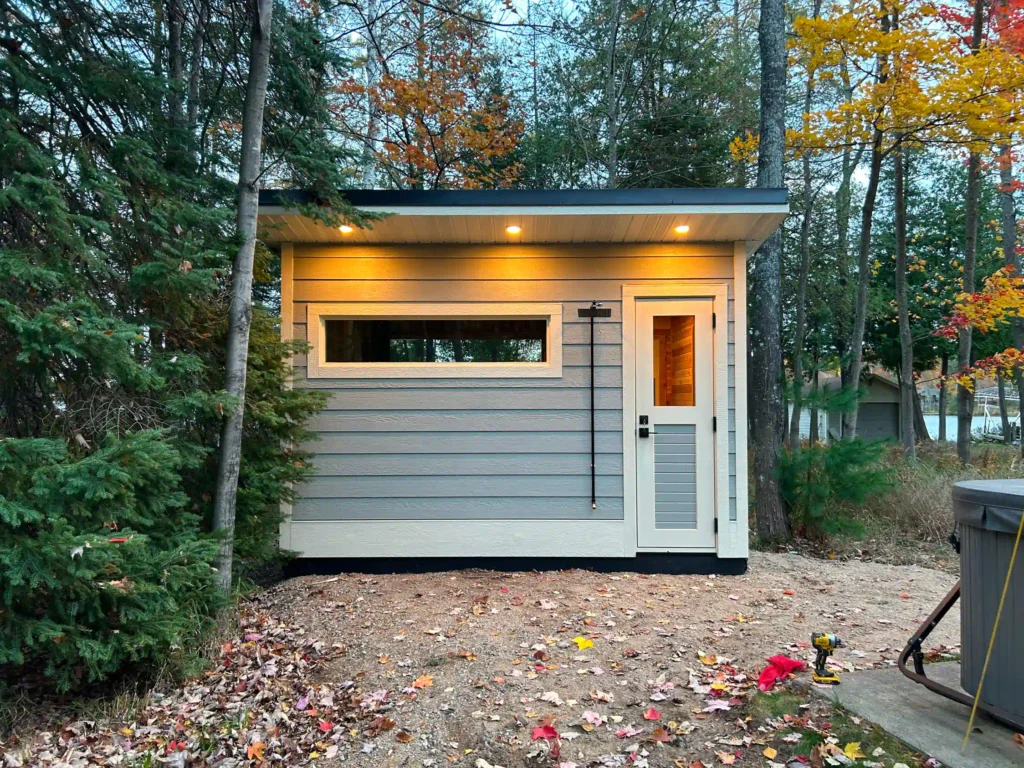
The Eagle Rivers project is an 8×12 freestanding custom sauna on a Northern Wisconsin lake property. It sits in the middle of the regional pattern: detached from the main residence, oriented toward the water, sited so the path from inside to lake is short enough that you take it in a towel.
Interior cladding is white cedar, tongue-and-groove. White cedar is the standard for Lake Country interiors for three reasons: low thermal conductivity (the wood does not burn skin at sauna temperatures), high natural rot resistance, and dimensional stability through the humidity swings of regular use. It is the species the Finnish-American builders of the Iron Range used when they could afford to specify, and it remains the species a custom-home architect specifies today.
Exterior cladding is thermally modified wood. Thermally modified ash or pine is kiln-processed at roughly 200 degrees Celsius, which removes the hemicellulose that water binds to and dramatically improves dimensional stability and rot resistance without chemical treatment. It weathers to a stable silver-gray and holds that color through the UV cycles of a lake property. The detail that matters for an architect: thermally modified cladding does not streak, warp, or check the way standard cedar or pine does over a decade of seasonal exposure on a lakefront elevation.
The framing is steel. Steel framing is hospitality-grade. It does not telegraph through interior finishes under the thermal cycling of regular sauna use the way a wood frame can. For a property at the luxury tier, the incremental cost is negligible. The lifespan difference is measured in decades.
What a custom sauna does for a lake home
The sauna does three things on a lake property that no other architectural element does.
It extends the season. A four-season lake home in Minnesota or Wisconsin is in active use roughly 280 days a year. The sauna is the structure that makes the cold weeks of that calendar functional rather than dormant. Snow on the deck, twenty-five below at the dock, sauna at eighty Celsius, lake water through a cut hole in the ice. The pattern is regional. It is also, per a 20-year longitudinal study from the University of Eastern Finland (Laukkanen et al., 2015, JAMA Internal Medicine), associated with a significant reduction in cardiovascular and all-cause mortality risk among regular sauna users.
It anchors the outdoor architecture. The lake home is organized around the water. The path from the residence to the dock is the structural spine of the property. A sauna sited on that path becomes part of the spine rather than an outbuilding. Good architects use it to articulate the transition from house to shoreline.
It holds its position in resale. Custom saunas in the Lake Country luxury tier are a documented buyer preference, not a depreciating amenity. A correctly specified white cedar and thermally modified build, sited well, is a feature the next buyer pays for. A kit-grade installation in a cabin shed is not.
Six specification anchors
A custom sauna for a luxury lake property is an architectural decision, not a product purchase. Six choices anchor the specification.
Siting
The sauna should occupy the path between the residence and the water, not break it. Setback from the waterline is governed by state and county shoreland ordinances. In Minnesota the typical setback is 75 to 100 feet from the ordinary high-water mark, with variation by lake classification. Wisconsin requires comparable distances. Orientation should account for prevailing wind off the lake, which influences flue draft and changing-room comfort. Size and proportion follow the property scale.
Stove
Wood-burning stoves are the regional default and the most authentic to the tradition. They require a roof flue, a fuel-storage protocol, and an owner who is willing to manage both. Electric stoves are appropriate for properties without easy wood handling, for partially enclosed installations, and for hospitality operators who are not training guests on fuel management. The full stove comparison is here.
Interior
White cedar remains the specification for Lake Country. Aromatic cedar is not appropriate inside a sauna. Hemlock and aspen are acceptable alternates for budget-sensitive builds, but white cedar is what the regional vernacular calls for and what a luxury buyer expects to see when the door opens.
Exterior
Thermally modified ash or pine for the upper tier. Standard cedar with a marine-grade finish for mid tier. Pressure-treated lumber is incompatible with the wellness positioning of any custom sauna and should not appear in a luxury specification.
Roof
Standing-seam metal matches the regional architectural vernacular and outlasts asphalt by decades. On a lakefront property where the roofline is visible from the water, this also resolves the aesthetic question.
Glass
A single large lakefront window is the most common request and the easiest specification mistake. Standard insulating units fail under sauna thermal cycling. The correct specification is tempered glass appropriate for high-temperature applications, with the gasket and frame system rated to match.
The Lake Country fit
The cabin-kit sauna culture that dominated the 1980s and 1990s no longer serves the Lake Country luxury market. A buyer who is specifying a custom home or a major renovation expects the sauna to meet the same specification discipline as the kitchen or the primary suite.
What the market wants is a build that integrates with the residence, the property, the regional vocabulary, and a tradition that did not arrive yesterday.
The lake invites the sauna
The Eagle Rivers project is one working example. BW has built variations of it across Minnesota and Wisconsin lake country for architects, custom-home builders, and direct-to-owner luxury buyers. The fundamentals do not change. White cedar inside. Thermally modified outside. Steel where the frame matters. Sited so the path to the water is short.
If a custom sauna is on the program for an upcoming lake-country build, BW can be brought in at the design stage. The fit between the build and the regional tradition is easier to achieve when the sauna is specified alongside the house, not added afterward.
Frequently asked
What is the right size for a custom lake-property sauna?
8×12 is the working standard for a residence-scale build. It accommodates a changing room, a sauna room, and bench seating for four to six. Larger builds (10×14, 12×16) are appropriate for compound-scale properties or commercial use. More on sizing here.
Wood or electric stove on a lake property?
Wood is the regional default and the answer for owner-occupied properties. Electric is the answer for screened or partially enclosed installations, hospitality use, and properties without practical fuel storage.
How far from the lake?
Minnesota shoreland ordinances generally require 75 to 100 feet of setback from the ordinary high-water mark, with variation by lake classification. Wisconsin requires comparable distances. Verify with the county zoning office before siting.
What is the working temperature for a traditional Finnish sauna?
Roughly 80 to 90 degrees Celsius (175 to 195 Fahrenheit) for the room, with löyly (steam) generated by water poured on the heated stones. Detailed temperature guidance here.
What is the lifespan of a correctly specified custom sauna?
White cedar interior, thermally modified exterior, steel framing, standing-seam roof, marine-grade hardware: 30 or more years of working life with normal maintenance.
Is sauna backed by clinical research?
Yes. The longest-running data set is the Finnish KIHD study (Laukkanen et al., 2015, JAMA Internal Medicine), which followed more than 2,300 Finnish men for roughly 20 years and found significant inverse associations between frequency of sauna use and cardiovascular and all-cause mortality. A 2018 systematic review (Hussain & Cohen, Evidence-Based Complementary and Alternative Medicine) and the 2018 Mayo Clinic Proceedings review (Laukkanen & Kunutsor) cover the broader evidence base.
Sources and further reading
Cultural and historical. Sisu Heritage Foundation (Embarrass, Minnesota); Minnesota Historical Society on Finnish-American settlement in the Iron Range; Wisconsin Historical Society on the Gogebic Range mining communities.
Clinical research. Laukkanen T, Khan H, Zaccardi F, Laukkanen JA. Association between sauna bathing and fatal cardiovascular and all-cause mortality events. JAMA Internal Medicine, 2015;175(4):542–548. Laukkanen JA, Kunutsor SK. Is sauna bathing protective of cardiovascular and other health outcomes? Mayo Clinic Proceedings, 2018;93(8):1111–1121. Hussain J, Cohen M. Clinical effects of regular dry sauna bathing: a systematic review. Evidence-Based Complementary and Alternative Medicine, 2018.
Internal references. Eagle Rivers 8×12 custom sauna project · Stove selection · Sauna temperature · Sizing · Crafting a home sauna in Minnesota · The wood-burning sauna tradition.