What Breaks First in Kit and Barrel Saunas
A technical breakdown of how prefab saunas fail under guest use, and what to know before putting one on a rental, resort, or wellness property.
The short version
- Mold in the wall cavity from vapor barrier gaps. Invisible for months. Most expensive failure on the list.
- Gap creep between boards after two seasons of heat cycles. Heater runs longer. Energy bills climb.
- Loose staves and roof leaks on barrel saunas in four-season climates.
- Heater burnout from running residential-rated units on commercial duty cycles.
- Most kit warranties exclude short-term rental and commercial use. Read the fine print first.
Residential use and commercial use are not the same problem. A backyard sauna runs twice a week. A sauna at a short-term rental, cabin retreat, ski lodge, or wellness studio runs five to fifteen sessions a day in season. Same heat cycle, same humidity load, ten times the frequency.
Anything weak in the construction shows up faster. Below is where kit and barrel saunas fail in commercial use, why they fail, and what those failures cost.
The construction problem starts at the factory
Most prefab kits are cut on a production line, packed flat, and shipped for on-site assembly by the buyer. Three issues come out of that workflow:
- Wood cut to drawing, not to fit. Cedar, hemlock, and spruce all move with humidity. A machine cutting to spec does not adjust for the species or for the seam. Gaps open after a few dozen heat cycles.
- Inconsistent vapor barrier. A sauna needs a continuous aluminum foil barrier on the warm side, sealed at every seam and penetration. Kits often skip seams or use the wrong material. The interior-to-exterior temperature gap in a sauna can exceed 150°F, and moisture finds any weak point.
- Face-stapled paneling. Tongue-and-groove cedar should be blind-nailed through the tongue so the boards can move slightly as they cycle. Face-stapled boards pop loose when the wood expands. In a daily-use rental, that shows up the first season.
Mold, water, and rot inside the walls
The most expensive failure is invisible for months. By the time you smell it, the wall cavity is already compromised.
The single vapor barrier rule
One barrier per wall, facing the heat. If both interior and exterior surfaces seal, moisture trapped between them has nowhere to go. That is the condition that grows mold inside the wall.
What it looks like to an operator
- Musty smell the cleaning staff cannot remove
- Dark staining where wall meets ceiling
- Soft, spongy spots where bench supports meet the wall
- Guests mentioning the smell in reviews
What it costs to fix
Opening the wall, replacing insulation, replacing the vapor barrier, refitting paneling. On a kit not built for replacement, the repair often costs most of what a new unit would.
Wood movement and gap creep
Cedar, hemlock, and untreated spruce move four to eight percent across the grain as humidity changes. Multiply that movement by hundreds of seams in a kit assembly. Multiply again by daily heat cycles in a commercial setting.
What happens within two seasons:
- Gaps form between boards
- Heat leaks out through the seams
- The heater runs longer to hit the same temperature
- Energy costs climb
- The room takes longer to warm up between guests
Thermally modified wood like Thermory locks moisture out of the cell structure and stays dimensionally stable through cycles. Untreated cedar does not.
Where barrel saunas fail
Barrels rely on stainless steel hoops compressing the staves. The seal is mechanical, not joined. That works in temperate climates with consistent humidity. It does not hold up to four-season Midwest weather.
Two specific weak points
- Stave thickness. Anything thinner than 1.5 inches warps and fails. 1.65 inches is the durable benchmark. Most imported barrels run at or below the minimum.
- Roof and weather exposure. The curved roof rarely has enough overhang. Water pools at the rear arc. Freeze-thaw cycles split the joints.
The guest experience problem the catalogs skip
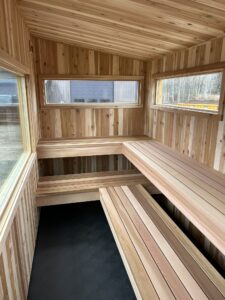
- One bench level only. No room to lie down.
- No room to lean against the side walls.
- Curved interior reads as cramped to a paying guest.
- Hard to photograph well for listing photos.
The thermal envelope
A kit or barrel sauna with no wall cavity relies on the wood itself for both structure and insulation. The R-value math is unforgiving:
- Solid 2-inch cedar stave: R-2
- Properly insulated wall assembly (cedar interior, foil vapor barrier, mineral wool in a 2×4 or 2×6 cavity, sheathing, weather-rated cladding): R-13 to R-23
What that means in practice:
- Insulated sauna reaches 180°F in 30 to 45 minutes. The barrel takes longer and often stalls under 180°F in winter.
- Insulated sauna holds temperature with the heater cycling. The barrel runs the heater near constantly.
- A barrel rated for 180°F may only deliver 160°F in a Minnesota January.
- Over five years of commercial use, energy cost on the insulated build is substantially lower.
Expected lifespan by price tier
Assuming five or more sessions per day.
Entry
$3,000 to $6,000 imported kit or barrel
- 2 to 4 years to first significant repair
- Thinner wood, minimal or absent vapor barrier work
- Residential-duty heater
- Most warranties exclude commercial and short-term rental use
Mid-tier
$8,000 to $15,000 prefab with thermally modified wood
- 5 to 8 years with diligent maintenance
- Better wood, better warranty
- Still production-line construction with limited site adjustment
Custom-built
$25,000 and up traditional Finnish sauna
- 20 to 30 years and longer
- Framed wall assembly, foil vapor barrier sealed in place
- Every joint cut to fit, no production-line shortcuts
- Thermally modified wood or grade-selected cedar
- Commercial-rated heater like IKI, built for the duty cycle
The cost-per-year math runs the same direction every time. A $5,000 sauna that lasts three years costs more annually than a $30,000 sauna that lasts twenty-five.
What this means for an operator
Backyard residence? A kit may last long enough to justify it.
Revenue-generating property? The math changes.
The guest experience has to be consistent. Mold smells, in-season heater repairs, and ninety-minute warm-up times do not read as investment in your reviews. They read as cutting corners.
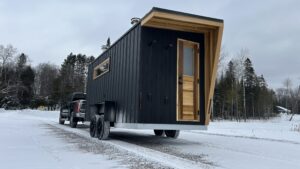
When BW builds for hospitality, the brief stays the same whether it is a permanent install at a lodge or a mobile sauna parked at a ski-in rental:
- Same insulation
- Same vapor barrier work
- Same heater class
- Same wood treatment
The failure modes documented above are the ones we hear about when an operator calls us after replacing their first kit sauna. They want the second one to be the last one.
If you are weighing a sauna for a short-term rental, lodge, or wellness property, we are glad to walk through what a build looks like for your site. Get in touch.
Sources
- Haven of Heat. How to Insulate a Sauna: Vapor Barrier, R-Values, and Common Mistakes. 2026.
- Sauna Marketplace. When NOT To Use A Sauna Vapor Barrier. 2025.
- Sauna Marketplace. 7 Reasons Barrel Saunas Fail. 2024.
- Pioneer Family Pools. Why You Shouldn’t Buy a Barrel Sauna. 2025.
- Ryt Saunas. Why Barrel Saunas Are the Worst Choice. 2025.
- Sun Home Saunas. Sauna Warranty Comparison: How to Read the Fine Print. 2026.