Backyard saunas are showing up across the Minneapolis suburbs with increasing regularity, and not as a passing trend. Homeowners in Minnetonka, Eden Prairie, Wayzata, and other west-metro communities are building permanent, high-quality saunas on their properties because they have the space, the budget, and the intent to use them year-round. This post covers what is driving demand for a custom sauna in the Minneapolis suburbs and what to think through before you commit to a build.
What’s Driving Sauna Demand in the Suburbs
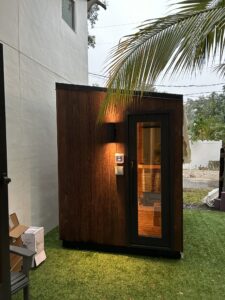
The simplest explanation is space. Most homes inside Minneapolis proper sit on lots under a tenth of an acre. Cross into the suburbs and lot sizes jump. A typical property in Plymouth or Maple Grove gives you a quarter acre or more to work with, and lake-adjacent lots in Minnetonka or Wayzata often run well beyond that. A backyard sauna needs roughly 60 to 100 square feet for the structure itself, plus clearance for access, ventilation, and setbacks. Suburban lots handle that without crowding the yard.
Income is the other factor. The western Hennepin County suburbs consistently rank among the highest household incomes in the state. Homeowners in these communities are not looking for the cheapest thing available. They want something built correctly that will last decades and hold its value as a permanent property improvement. That mindset points toward custom construction.
Minnesota’s climate plays a role too. This is a state where people use their backyards twelve months a year. Ice fishing, snowshoeing, backyard hockey rinks. A sauna fits that pattern. It is an outdoor structure that gets more use in January than in July. The COVID-era shift toward investing in home properties accelerated the timeline for a lot of homeowners who had been thinking about a build, and that momentum has stuck.
Custom Build vs. Prefab: What Suburban Homeowners Are Choosing
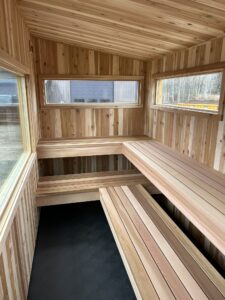
The difference between a custom-built sauna and a prefabricated unit comes down to how seriously the structure is engineered for its actual purpose. A custom build starts with the specific dimensions, heating requirements, and site conditions of your property. Wall thickness, insulation type and depth, vapor barrier placement, ventilation design, wood selection. All decisions made for that particular sauna, not compromises dictated by a standard production model.
Insulation is where the gap shows up most. Minnesota winters regularly push below zero. A sauna that cannot hold its heat in those conditions costs more to run and delivers a worse experience every session. Every sauna we build is fully insulated through the walls, ceiling, and floor. Not an upgrade package. That is the baseline, because there is no version of a Minnesota sauna where skipping insulation makes sense.
Heat retention ties directly to longevity. A well-insulated sauna reaches operating temperature faster, maintains it with less energy, and puts less thermal stress on the heater and interior wood over time. The result is a structure that performs consistently for decades. For homeowners treating this as a permanent addition, that durability is the whole point. You can see the full range of our custom sauna builds on the main product page.
Mobile Saunas for Suburban Properties
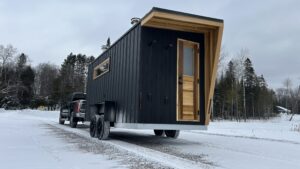
Not every project calls for a permanent structure. A purpose-built mobile sauna, sometimes listed as a trailer sauna, fits homeowners who want flexibility. Lake cabins or second properties where a permanent build is not worth the permitting process. Airbnb or short-term rental setups where the sauna adds value but may need to move if the property sells. Primary residences where the homeowner wants to reposition seasonally or haul the unit up north for the summer.
Our flagship mobile sauna uses a roll-down system that sets the cabin flat to the ground, completely off the trailer frame. This matters. The sauna is not perched on an axle during use. It comes down to grade, sits level, and functions like a permanent structure for as long as it stays in place. When it is time to move, the cabin rolls back onto the frame and travels like any other trailer. More detail on the build process is on the mobile sauna page.
For Minneapolis-area homeowners with a cabin up north or a lakeshore property in the Brainerd Lakes area, a mobile sauna covers both locations with one investment. Build once, move it where you need it.
Popular Suburbs and What We’re Seeing
The western suburbs generate the most interest, and that tracks with lot sizes and income. Minnetonka and Wayzata homeowners tend toward lake-adjacent properties where the sauna becomes part of a waterfront setup, often paired with a cold plunge in the lake. Eden Prairie and Plymouth see more standard backyard builds on larger residential lots, typically positioned near an existing patio or deck. Maple Grove has grown steadily as a market. Newer construction on bigger lots means homeowners are planning outdoor features from the start rather than retrofitting later.
On the east side of the metro, Woodbury is the most active suburb for sauna inquiries. The lots are generous by metro standards, and the community has a strong culture of outdoor home investment. Builds there tend to be straightforward site-prep situations with good access and flat grading, which keeps the project timeline tight.
Delivery-wise, our shop in Duluth puts the Minneapolis metro about two and a half hours south on I-35. Close enough for delivery, site visits, and ongoing communication without the overhead of a metro-area location. Our Build Division handles local construction in the Duluth and Superior area, while custom and mobile sauna builds ship to the Twin Cities and beyond.
What to Expect: Timeline, Permits, and Cost
A custom sauna build starts with a design conversation to establish scope: size, heating method, interior layout, placement on the property, permanent or mobile. From there, we provide a detailed proposal. Once a project is confirmed, build timelines typically run six to twelve weeks depending on complexity, shop workload, and material availability.
Permits in the Minneapolis suburbs fall under the jurisdiction of the individual city, though most of western Hennepin County follows similar patterns. A permanent sauna with electrical work will generally require a building permit and an electrical permit. Setback requirements vary by municipality, so pull your property survey early. For mobile saunas, permit requirements are often lighter since the structure is not permanently affixed, but confirm with your local building department before delivery.
On cost, we do not publish set pricing because every build is different. Size, heating system, interior wood species, permanent vs. mobile, site prep complexity. All of it factors in. What we do not do is cut corners on insulation, materials, or build quality to hit a lower number. Every sauna leaves our shop fully insulated, fully finished, and built to last in this climate. If your priority is a sauna that performs and holds up, that is the conversation worth having.
Talk to BW About Your Minneapolis Sauna Build
If you are a homeowner in the Minneapolis suburbs considering a backyard sauna, the next step is a conversation about your property, your goals, and your timeline. We build custom, fully insulated, American-made saunas and deliver across Minnesota. Whether you are looking at a permanent backyard build in Eden Prairie or a mobile unit that splits time between Plymouth and your lake cabin, we can walk you through what the project looks like start to finish. Get in touch to start planning your Minneapolis sauna build