
From the Cabin / Sauna and Off-Grid Power
Can you run an electric sauna heater at a cabin that isn’t on the grid?
Up here in the Northwoods, a lot of us bought the cabin for the water and the quiet, not for the wiring. Plenty of places along the lakes of northern Minnesota, up through the Wisconsin woods, and out into Alaska never had a power line run to them. You get by on solar, a generator in the shed, and maybe a battery bank you have been babying. And sooner or later, if you love a good sweat after the lake, the question comes up: can I put in an electric sauna heater and actually run it out here?
Short version, two of the three common off-grid setups can do it, and going electric has some real advantages over a wood stove. Here is the honest breakdown.
What you are asking the power to do
An electric sauna heater is a resistive load, the same family as your electric range or a tank water heater. No motor, no startup surge, so the power it pulls the second you flip it on is the same power it pulls an hour later. That part is easy. What is not easy is how much, and for how long. Most cabin-sized heaters run between 3 and 9 kW, and once you get past the little ones they want 240 volts, not the 120 at a standard outlet.
What each heater pulls at 240 V
Path one
Build your own at the cabin
The summer project. You frame a little hot room by the shore or out at the fish camp and wire the heater in yourself.
Path two
Tow one in on a trailer
The plug-and-go. A mobile sauna you back up to the cabin and connect to whatever power you already run.
Path one, building your own
For a lot of folks the sauna is the summer project. You are already out there fixing the dock and re-chinking the logs, so you frame a small room, line it in cedar, and wire in a heater. If you are stuck deciding between a wood-burning stove and an electric heater, the electric side has two things going for it that matter a whole lot in a small wooden building in the middle of the woods.
Fire risk drops off. A wood stove means an open firebox, a hot flue running up through your roof, sparks, and ash, all inside a cedar-lined box on a lot that is bone dry by August. An electric heater has none of that. No flame, no chimney, no embers landing on the shingles or the pine needles. For a building you cannot see from the fire hall, that is worth real peace of mind.
The install is lighter. A wood burner wants a chimney, a roof penetration, clearances to everything that can catch, and a woodpile you keep splitting all season. An electric heater wants a properly sized circuit and a wire. That is a much smaller build and a lot less to keep up, especially if the sauna is a long weekend and not a whole summer.
The catch is power, and this is where your off-grid setup has to earn its keep.
Running it off the generator
The generator in the shed is the most direct answer, and the heater actually makes it easy on you. Because there is no startup surge, you size the genny to the running watts plus about a quarter for headroom, not to some spike. A 6 kW heater wants roughly a 7.5 kW generator, an 8 kW heater about 10 kW. Two things have to be true. It has to put out real 240 volts, which knocks out most little jobsite units, and it has to keep running through the whole heat-up and your sit, so plan your fuel. Run it as a plain heat load and even a conventional generator handles it fine.
Heater draw vs. the generator you want behind it
6 kW
8 kW
9 kW
Heater running draw
Generator with headroom
VerdictWorks well. Real 240 V output, sized for running watts plus about 25 percent, and enough fuel for the sit.
Straight off the solar panels
Panels to heater with nothing in between is the one setup that does not pan out. To feed a 6 kW heater in real time your array has to be making 6 kW right then, call it a 7 to 8 kW system after losses, and the first cloud that rolls over the lake pulls the rug out mid-session. Solar hands you plenty of energy, just slowly and on its own schedule. The heater wants a big steady pull the moment you ask for it.
VerdictNot on its own. The supply comes and goes, and the heater needs a load it can hold.
Off the battery bank
A battery is what ties the whole thing together, because it lets you gather power slow and spend it fast. Charge it off the panels all afternoon, or top it off with the generator, then let it swing the heater when you want to sweat. Watch two numbers. The inverter has to hold at least the heater’s rating and, for most heaters, put out 240 volt split phase, which the little portable power stations usually cannot do alone but a real home battery can. And the pack needs the energy for one sit. A typical session, about a 40 minute heat-up plus an hour of cycling to hold temperature, runs somewhere around 6 to 8 kWh, so an 11 to 13 kWh battery covers a sit or two and refills off the sun between uses.
Energy for one typical sit, about 6.8 kWh
Heat-up 4.0 kWh
Hold 2.8 kWh
Bringing the room up to heat
Cycling to hold it there
VerdictBest off-grid fit. Size the inverter for continuous kW and 240 V, and the pack for kWh per sit.
Whatever you feed it with, a sauna heater is one of the biggest steady loads you will ever put on a cabin system, so the breaker, the wire, and the connection are not the place to eyeball it. Have the circuit sized and the hookup done by a licensed electrician, and you can run electric out here with the same confidence you would in town.
Path two, and did you know a mobile sauna can run electric?
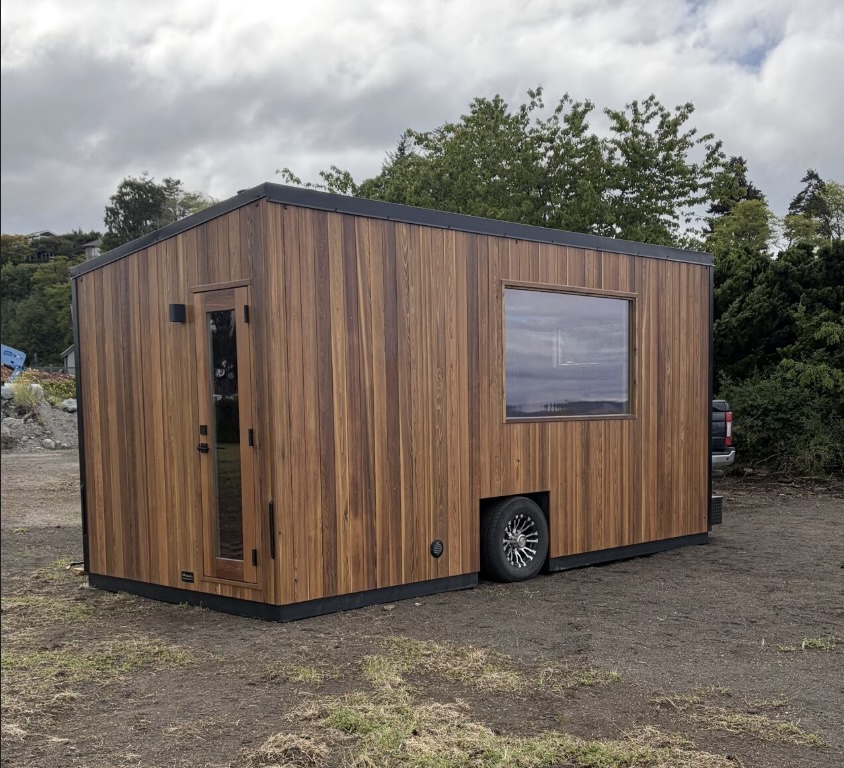
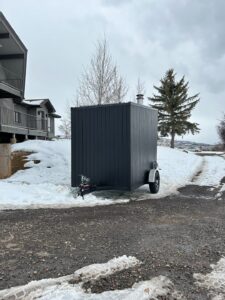
Here is the part that surprises people. You do not have to build a thing. A mobile sauna, the kind on a trailer you tow right up to the cabin, can be set up with an electric heater instead of a wood stove. It sounds a little unconventional, since most folks picture a smoking chimney on a trailer sauna, but it is one of the options we build.
Off the grid, the appeal is the same story as above, just already done for you. No chimney to babysit and no fire to tend. You back it in by the shore, plug it into the generator or your battery setup, and it heats. When the fishing is better on the far side of the lake next season, you hitch up and the sauna comes along. For a cabin that runs on a generator anyway, a mobile electric sauna is about as close to plug-and-go as a sauna gets.
Before the first burn it is worth having experienced electrical pros confirm your generator or battery can carry the heater and that the connection is right. After that, it is just you and the steam.
Which setup does what
What matters at the cabin
Generator
Solar only
Battery
Holds power at 240 V
Energy for a full sit
Steady, clean voltage
No fuel to haul
Easy on the wallet up front
Quiet and low fuss
Three filled dots is strong, two is fair, one is weak.
So, is it wise, and is it possible? Possible, yes, on a generator or a battery bank, and often the smarter call than a wood stove once you count the fire risk and the lighter install. Not on solar by itself. Get the load math right and the heater does not care whether the power came off the grid or out of the shed. Fire it up, and then go jump in the lake.