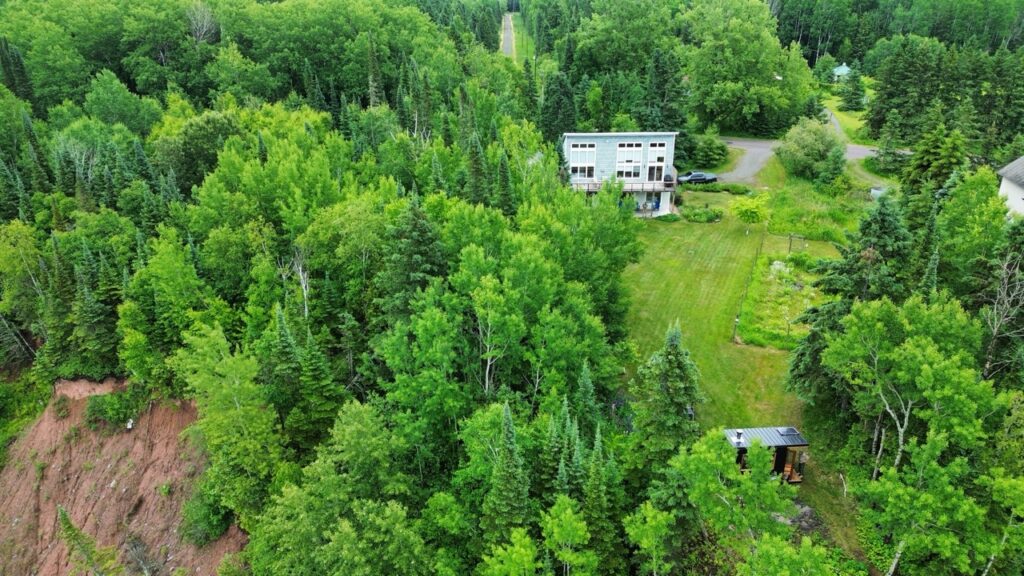
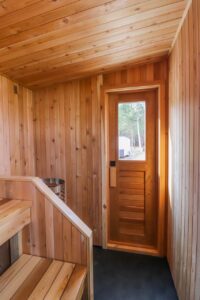
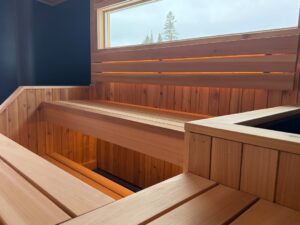
Nobody calls us to ask about generators. It comes up sideways, near the end of a conversation about a cabin build, and it sounds like this: what happens when the power goes out?
The timing is what makes it fair. The nights you most want a hot room and a cold walk back are the nights the grid is under the most stress. If your heater runs on electricity, the storm that makes the sauna worth firing is the storm that can take it away. On a city service that is a rare inconvenience. On a cabin fed by a rural cooperative, or a property running on a generator or a solar array, it is a design decision you make once.
The short answer
A generator will run an electric sauna heater. Whether yours will comes down to three numbers: the heater’s rated kilowatts, the generator’s continuous output, and what else is running at the same time.
Resistive heat has no starting surge, so it never spikes the way a well pump does. That sounds like the easy case. It is harder in a different way. A sauna heater pulls its full rated power the entire time it is calling, which is most of the heat-up and a good share of the session.
What an electric sauna heater pulls
Start with the room. Harvia’s own guidance is roughly 1 kW of heater output per cubic meter of interior volume, with more required when the room has glass or heat-storing surfaces. That is about 35 cubic feet per kilowatt, and the published ranges for common residential heaters line up with it.
| Heater | Interior volume it covers | Current at 240V | Where it shows up |
|---|---|---|---|
| 4.5 kW | 100 to 210 cu ft | 18.8 A | Small two to three person room |
| 6 kW | 170 to 300 cu ft | 25.0 A | Most common residential size |
| 8 kW | 250 to 425 cu ft | 33.3 A | Larger backyard and home builds |
| 10 kW | 350 to 600 cu ft | 41.7 A | Big rooms, glass walls, cold climates |
| 15 kW | 550 to 900 cu ft | 62.5 A | Commercial and light commercial |
Current is rated kilowatts divided by 240 volts. Size the circuit from the manufacturer’s manual. Most heaters in this range need a dedicated 240V circuit, and because the breaker is sized above the heater’s rated current, anything past 9 kW commonly lands on a 60 amp circuit.
Glass and cold both push you a size up. If you want to run the numbers yourself, our sauna heater size calculation covers the volume math and the electric heater installation guide covers the circuit.
Why a heater is a harder load than a well pump
Generator sizing charts are built around motors, because motors are the dramatic load. A half horsepower well pump runs at 900 watts and surges to 2,500 for a second. You size for the surge, it passes, you get your headroom back.
Resistive loads do the opposite. In its 2026 breakdown of standby versus portable systems, Piedmont electrical contractor Wires R Us lists an electric water heater as 1,100 to 4,500 running watts with no starting surge, but a continuous hog, and concludes a 7,500 watt portable covers the essentials plus one motor load while an electric water heater will not fit on it at all. A sauna heater is the same animal, usually larger. The rule that matters most from that piece: target 80 percent of the running rating, not the starting rating.
Matching heater size to generator size
Run the heater alone first, then add the building.
| Heater | Continuous draw | Minimum running rating | Nameplate near Rapid City | Nameplate near Lead |
|---|---|---|---|---|
| 4.5 kW | 4,500 W | 5.6 kW | 6.3 kW | 6.8 kW |
| 6 kW | 6,000 W | 7.5 kW | 8.4 kW | 9.1 kW |
| 8 kW | 8,000 W | 10.0 kW | 11.2 kW | 12.2 kW |
| 9 kW | 9,000 W | 11.3 kW | 12.6 kW | 13.7 kW |
| 10 kW | 10,000 W | 12.5 kW | 14.0 kW | 15.2 kW |
| 15 kW | 15,000 W | 18.8 kW | 21.1 kW | 22.9 kW |
Heater only, nothing else running. The last two columns apply the elevation derate below. Confirm the derate curve for your unit and your actual site elevation before buying anything.
One piece of good news. A 240 volt resistive heater draws evenly across both legs, so it does not create the imbalance a stack of 120 volt loads can. What it does need is real 240 volt capacity at the receptacle you plan to use, which not every portable has. Check the outlet rating, not just the total watts on the label.
The Black Hills number no calculator applies
Every generator nameplate is a sea level figure. Thinner air means worse combustion and less output. Manufacturer spec sheets put it at about 3.5 percent less maximum power for every 1,000 feet above sea level, with portables closer to 3 percent. That same breakdown puts downtown Rapid City at roughly 3,202 feet, Deadwood starting around 4,531 feet, and Lead higher still, which is about 11 percent of a nameplate gone in Rapid City and 18 percent in Lead.
Applied to a sauna, an 8 kW heater that needs a 10 kW generator at sea level needs something north of 12 kW at a cabin above Deadwood. Most people buying a generator for a remote build are buying it in a valley and using it on a ridge.
South Dakota is one of the more reliable places in the country to be a utility customer, with federal data showing under two hours of total service interruption for all of 2024. The case for backup power here is not the average, it is the tail. A November 2025 transmission event took the entire Black Hills Energy network down for most of a day, and a record December wind event left thousands out for days.
Why the sauna should be first to shed
Take a realistic winter cabin: furnace blower at 700 watts, refrigerator at 300, freezer at 300, well pump at 900, lights and electronics at 500. That is 2,700 watts before the sauna exists. Add an 8 kW heater and you are at 10,700 continuous, plus a 2,500 watt surge any time the well kicks on mid session. That is a 22 kW standby’s problem, not a 10 kW portable’s.
There is a cleaner fix than a bigger machine. Optional standby systems fall under NEC Article 702, and 702.4 requires either capacity for all loads served or automatic load management that prevents overload, with Article 750 letting a smaller generator serve a whole building by shedding the water heater or the air conditioning first. Put the sauna circuit in that shed group. It is the most sheddable load in the building. Nobody’s pipes freeze because the sauna took twenty minutes off while the well ran.
If the plan involves a portable, the connection has to be a listed interlock kit or a transfer switch. A cord into a dryer receptacle is never an option, because it energizes the service drop. Both paths are permitted electrical work.
Fuel, which is where this gets decided
A session is a block of runtime, not a moment. Figure 30 to 60 minutes of heat-up at full draw, then a session where the heater cycles. On an 8 kW heater that is somewhere near 12 to 16 kWh, depending on the wall system, the glass, and the outside temperature.
Priced in propane, published figures put a 500 gallon tank at about 400 usable gallons and a 22 kW unit at half load burning 1.8 to 2.0 gallons per hour. Three hours of runtime for a sauna is five to six gallons. Gasoline is tighter: a 7,500 watt portable with a 6 to 8 gallon tank runs 6 to 8 hours at full load, and a sauna heater holds it near full load the whole time. You are converting most of a tank into one sauna.
Carbon monoxide is the real risk with portables, not the wiring. CPSC guidance counts about 100 deaths a year in the United States from portable generator carbon monoxide, with the rule being outside only and at least 20 feet from the building. Firing a sauna during a blizzard means that machine runs outside, downwind, for three hours. Work out where it lives before the storm.
Off-grid solar is a different constraint
Battery systems fail this load for another reason. Capacity is rarely the binding number, output is. Residential systems generally store 10 to 20 kWh and deliver 5 to 11.5 kW of continuous power, with most single units in the 5 to 7 kW range. An 8 kW heater is above that before you add the well pump. And one sauna at 12 to 16 kWh is most of a standard battery, in December, when the array produces least.
Storage integrators, including GenPro Energy Solutions in Piedmont, design islanded systems around a site’s real load profile rather than a nameplate, which is the right way to treat this. A sauna heater is one of the largest single loads on an off-grid property. There are three honest answers: size the inverter and array around it from the start, schedule sauna nights around production and battery state, or keep the heat off the electrical system entirely.
What we specify for remote sites
Wood, in most cases. We build with IKI, Kuuma, and Harvia heaters, and on a property where power is a question, a wood stove is the only heater in the building that does not care what the grid is doing. No transfer switch, no load calculation, no fuel curve, no derate for elevation.
That is not a knock on electric, which is the right call for an interior home sauna on a solid service. The comparison is worth reading on its own terms in electric or wood burning stove for a sauna, and it is why we have built both stoves into the same room for an operator who wanted electric during the week and wood on the nights that mattered. The other lever is the building itself. A tighter wall system means a smaller heater and a shorter duty cycle, which means a smaller generator. That is covered in the heat layers of a trailer sauna, and on a mobile build headed somewhere remote it often decides whether the generator on site is already enough.
How to plan it before the walls close
- Get the heater nameplate first. Rated kilowatts and voltage, off the manual. Every number downstream comes from it.
- Have a licensed electrician run the load calculation for the building with the heater in it, not the heater alone.
- Decide the shed priority up front. The sauna circuit should be first off and last back on.
- Get the fuel curve at your load, not the marketing figure at half load.
- Confirm your actual site elevation, not the nearest town’s.
- Rough it in during the build. Conduit and a circuit put in while the trades are on site cost a fraction of adding them later, the same point Wires R Us makes about new construction electrical work.
Can a generator power an electric sauna heater?
Yes, if the generator’s continuous output covers the heater plus everything else running. A sauna heater is a resistive load with no starting surge, but it draws its full rated power the entire time it is calling. Plan on the heater’s rated kilowatts divided by 0.8 as a minimum continuous generator rating, then add the building’s other loads and the largest single motor surge on the property.
What size generator do I need for a 6 kW sauna heater?
At sea level, a 6 kW heater needs at least 7.5 kW of continuous generator capacity for the heater alone, using the standard target of 80 percent of the running rating. In the Black Hills, elevation derate pushes that to roughly 8.4 kW of nameplate near Rapid City and about 9.1 kW near Lead. Add the cabin’s other loads on top of that figure, not into it.
Will a 7,500 watt portable generator run a sauna heater?
It will run a small heater and very little else. Published guidance on 7,500 watt portables is that they cover household essentials plus one significant motor load, and that an electric water heater will not fit on top of that at all. A sauna heater behaves the same way. A 4.5 kW heater is realistic if the essentials are light. A 6 kW heater leaves almost no headroom, and an 8 kW heater is beyond it.
How much fuel does it take to run a sauna on a generator?
Figure the session as generator runtime. An 8 kW heater over a heat-up plus a session is roughly 12 to 16 kWh. Published propane figures for a 22 kW standby at about half load run 1.8 to 2.0 gallons per hour, so a three hour window is five to six gallons. A gasoline portable with a 6 to 8 gallon tank running near full load is looking at most of a tank for one session.
Can a home battery or off-grid solar system run a sauna heater?
Sometimes, and the limiting number is usually continuous output rather than storage. Residential batteries typically store 10 to 20 kWh and deliver 5 to 11.5 kW continuous, with most single units in the 5 to 7 kW range, so an 8 kW heater is at or above the inverter’s rating. Storage is the second problem: one session can consume most of a standard battery, in the season when an array produces least. Off-grid electric works when the inverter and array are sized around the heater from the start.
Is a wood burning sauna better for an off-grid cabin?
For most off-grid properties, yes. A wood stove has no electrical load, no transfer switch, no fuel curve, and no elevation derate. It works during the outage that made you want the sauna in the first place. Electric makes more sense for interior home saunas on a solid service, where timer control and no wood handling are worth more than grid independence.
Does the sauna need its own circuit and permit?
Yes. Most residential electric sauna heaters between 4 and 9 kW require a dedicated 240V circuit, and heaters past 9 kW commonly require a 60 amp circuit. Circuit and conductor sizing comes from the heater’s installation manual and has to be done by a licensed electrician. Generator connections, whether an interlock kit or a transfer switch, are permitted electrical work as well.
Building somewhere the power is a question
Tell us the site, the power situation, and how you want to use the room. We will tell you whether the heat should be electric or wood before it costs anything to change your mind.
Talk to us about your buildSources: Wires R Us, Whole Home Standby vs Portable and Transfer Switch, 2026 Black Hills Electrical Guide and new construction electrical, for generator sizing method, appliance loads, NEC Article 702 and 750, elevation derate, fuel and runtime figures, and CPSC carbon monoxide guidance. GenPro Energy Solutions, Battery Storage and Microgrid Solutions, for islanded storage design. Harvia, electric heater sizing guidance.