

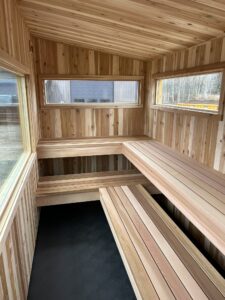
A 180-pound adult who spends an hour in a 185 °F sauna burns about 111 to 118 calories. That same person sitting on a bench in a cool room for an hour burns about 86. The heat is worth the difference, which is 25 to 32 calories.
That is the entire effect. A sauna burns calories, far fewer than the internet claims, and almost none of the weight you lose in the room is fat. Other common sessions, same 180-pound adult at 185 °F:
- One 30-minute sit: about 55 to 59 calories total. Roughly 43 of those you would have burned sitting on your couch, so the heat is responsible for about 12 to 16.
- A two-hour visit, four 15-minute rounds with breaks: about 213 to 221 calories total, of which about 42 to 49 come from the heat. That is the equivalent of adding ten minutes of brisk walking to your day.
- The weight you lose on the scale: roughly 0.5 kg of fluid per session, and it comes back the moment you rehydrate. None of it is fat.
- What the heat is good for: cardiovascular load comparable to moderate exercise, lower cortisol, better recovery and sleep. Not fat loss.
Run your own numbers below. The arithmetic behind the calculator, and the reason your watch reports something three or four times higher, are both explained further down.
Sauna calorie calculator
Built on the standard resting-energy equation with the measured heat increase applied. It reports total calories and, separately, the part the heat is actually responsible for.
Calories from the heat
12 to 16
About the same as adding three minutes of brisk walking to your day.
- Total burned during the visit
- 55 to 59
- You would have burned sitting anyway
- 43
- Time in the building
- 30 min
An estimate for comparison, not a metabolic measurement of you. Lean mass, hydration, heat adaptation and fitness all move the real figure.

Two honest numbers, and why they disagree
Search this question and you will get answers ranging from 50 calories to 1,000. That spread is not a difference of opinion. It is a difference of measurement method, and once you understand the two methods the whole topic gets simple.
The first number comes from a metabolic lab. Leppäluoto and colleagues put ten healthy men in a Finnish sauna at 80 °C for an hour, twice a day, for a week, and measured metabolic rate directly. It rose 25 to 33 percent after the first day of exposure (Acta Physiologica Scandinavica, 1986). A 25 to 33 percent bump sounds like a lot until you do the arithmetic. Resting, an average adult burns a little over one calorie per minute. Add a third to that and you are adding roughly 10 to 25 calories across a half hour.
The second number comes from heart-rate monitors. Podstawski and colleagues ran 45 overweight, sedentary young men through four 10-minute rounds at 90 to 91 °C with five-minute cool-down breaks, and recorded energy expenditure with wrist-worn heart-rate devices (BioMed Research International, 2019). The figures were 73.04, 93.82, 114.91 and 131.40 kcal across the four rounds. Roughly 413 kcal for the full protocol. That study is the source of nearly every “300 to 400 calories” headline you have read.
Energy expenditure per 10-minute round, 90–91 °C
Podstawski et al., 2019. Mean values for 45 overweight, sedentary men aged 19 to 24 who rarely used a sauna, across four 10-minute rounds separated by five-minute cool-downs. The highest individual round reached 153 kcal. These are heart-rate estimates, not calorimetry.
Both studies are real. Neither is lying. The lab number tells you what your body actually spent. The wrist number tells you what a heart-rate algorithm thinks your body spent, and in a hot room those two things come apart.
Why your watch overstates a sauna
Every fitness tracker estimates calories the same way. It reads your pulse and converts it to energy expenditure using a relationship built from exercise data, where a higher heart rate means your muscles are pulling more oxygen.
Heat breaks that relationship. When your core temperature climbs, your body moves a large share of circulation toward the skin to shed heat. Stroke volume falls, heart rate climbs to compensate, and oxygen uptake barely moves. Researchers call the heart-rate component driven purely by temperature thermal cardiac reactivity, and it runs anywhere from 16 to 60 extra beats per minute for every degree Celsius of body temperature (Frontiers in Physiology, 2019). The same literature flags it as a known source of error when metabolic rate is estimated from heart rate.
So a pulse of 140 on the bench does not mean the same thing as a pulse of 140 on a treadmill. The heart is working hard. The furnace is not. The Podstawski authors said as much themselves, noting in their limitations that the reliability and validity of heart-rate monitors under extreme conditions still needs testing.
Validation research backs that up in ordinary conditions, before heat is even in the picture. A Stanford team tested seven wrist devices against electrocardiography for heart rate and against indirect calorimetry for energy expenditure (Shcherbina et al., Journal of Personalized Medicine, 2017). Heart rate was measured well. Calories were not. The best device missed by 27 percent on average and the worst by 93 percent. A later systematic review found the same pattern across brands. In a hot room, where pulse climbs without limb movement, the error only gets larger.
That is the honest range. It also explains why body mass in those studies was the strongest predictor of expenditure. A bigger body has more mass to heat and more surface to cool, so it spends more. A 110-pound person and a 260-pound person do not get the same number, and no calculator that ignores body mass is worth much.
What that works out to at your body weight
Here is the arithmetic, run honestly. Start with the standard equation used to convert body weight and time into resting calories, where one MET is an adult resting rate of about 3.5 millilitres of oxygen per kilogram per minute:
resting calories = 3.5 × body weight in kg × minutes ÷ 200
Then apply the measured heat increase of 25 to 33 percent. For a 180-pound adult in a 20-minute session, that is 3.5 × 81.6 × 20 ÷ 200, which gives 28.6 resting calories. Multiply by 1.25 to 1.33 and you land at 36 to 38 total.
The number that matters is the third column. You would have burned those 28.6 calories sitting in your kitchen. The heat is responsible for the difference, which here is seven to ten calories.
| Body weight | Session | Total calories | Burned sitting anyway | Extra from the heat |
|---|---|---|---|---|
| 120 lb | 20 min | 24 to 25 | 19 | 5 to 6 |
| 30 min | 36 to 38 | 29 | 7 to 9 | |
| 150 lb | 20 min | 30 to 32 | 24 | 6 to 8 |
| 30 min | 45 to 48 | 36 | 9 to 12 | |
| 180 lb | 20 min | 36 to 38 | 29 | 7 to 10 |
| 30 min | 54 to 57 | 43 | 11 to 14 | |
| 210 lb | 20 min | 42 to 44 | 33 | 8 to 11 |
| 30 min | 63 to 67 | 50 | 13 to 17 | |
| 240 lb | 20 min | 48 to 51 | 38 | 10 to 13 |
| 30 min | 71 to 76 | 57 | 14 to 19 |
The table runs at 176 °F (80 °C), the temperature the metabolic study used. A hotter room shifts the figures up a few calories, which is what the calculator at the top adjusts for. These are estimates for comparison, not a metabolic measurement of you specifically. Age, sex, lean mass, hydration, heat adaptation and room temperature all move the real figure. What the table does establish is the order of magnitude. Even a heavy user running a long session is adding calories in the teens, not the hundreds.
Set that against the wrist-monitor studies and the gap is the whole story. The same 20 minutes that this model prices at roughly 36 calories came out at 118 calories when 2024 researchers measured young women with Polar monitors at 80 °C. Neither figure is fabricated. One is arithmetic from oxygen cost, the other is an algorithm reading a hot heart.
The scale drops. That is water.
Step on a scale after an hour in a hot room and you will be lighter. A single traditional session costs most people about 0.5 kg of fluid, and heavier users lose more (Experimental Gerontology, 2021). In the Podstawski group, young overweight men averaged 0.65 kg across four rounds.
None of that is fat. Fat loss requires oxidizing stored energy, and oxidizing half a kilogram of fat takes somewhere near 3,500 calories. You did not spend 3,500 calories sitting on a cedar bench. You evaporated water off your skin, and you will put every gram of it back with two or three glasses of water.
There is a practical version of this rule. Weigh yourself before the sauna, not after. Then drink roughly 16 to 24 ounces for every pound you came out lighter. The post-sauna number on the scale is a dehydration reading, not a progress report.
What the heat is genuinely good at
Calorie burn is the weakest reason to own a sauna. It is also the most searched one, which is how a modest 40-calorie effect ended up carrying a thousand-calorie reputation. The research that actually holds up points somewhere else.
- A real cardiovascular load. Heart rate climbs to roughly 100 beats per minute at moderate temperatures and up to 150 in a hotter room, which is the same territory as moderate to vigorous exercise. In a direct comparison of 19 adults, the cardiac load of a 25-minute session and a bout of moderate physical exercise came out close to equivalent.
- Mortality data with real follow-up. In a 20-year prospective study of 2,315 middle-aged Finnish men, sauna frequency tracked with lower rates of sudden cardiac death and fatal cardiovascular disease, with the strongest association at four to seven sessions per week (Laukkanen et al., JAMA Internal Medicine, 2015). That is association rather than proof, and it is still the most substantial dataset in the field.
- A measurable drop in stress hormones. Thirty young men running four 12-minute sauna rounds with one-minute cold immersion between each saw serum cortisol fall from 13.61 to 9.67 µg/ml across 72 minutes. The men who walked in with the highest cortisol dropped the furthest (Podstawski et al., American Journal of Men’s Health, 2021).
- Recovery that makes training possible. A systematic review of regular dry sauna bathing found consistent effects on circulation, blood pressure and perceived recovery (Hussain & Cohen, 2018). Heat does not replace the training that moves the scale. It helps you keep showing up for it.
Read that list again and notice what is missing. Nobody has shown meaningful fat loss from heat alone. A sauna is a cardiovascular and recovery tool that happens to burn a few calories, not a calorie tool that happens to help your heart.
How to use a sauna if body composition is the goal
| Claim you will see online | What the research supports |
|---|---|
| Burn 600 to 1,000 calories per session | Not supported. 73 to 131 kcal per 10-minute round by heart-rate estimate, and considerably less by direct metabolic measurement. |
| Lose three pounds in a session | Misleading. 0.3 to 0.65 kg of fluid, replaced on rehydration. |
| Sauna melts fat | Not supported. No study has shown meaningful fat mass change from heat exposure alone. |
| Sauna is as good as cardio | Partly. Cardiac load is comparable. Skeletal muscle loading, which drives lean mass and long-term metabolic rate, does not happen in a sauna. |
| Sauna helps you stay consistent | Supported indirectly. Recovery, sleep and adherence benefits are well documented in regular users. |
Turning the heat up is not the lever
A hotter room does raise the number, and it costs you more than it returns. In a 2024 study, young women who used the sauna only occasionally ran two 20-minute sessions, one at 80 °C and one at 120 °C (Podstawski et al., Frontiers in Public Health, 2024). Estimated expenditure rose from 118.6 to 186.0 kcal. So far that sounds like an argument for cranking the stove.
The mood data says otherwise. After the 80 °C session, vigor rose and tension, depression, anger, fatigue and confusion all fell. After the 120 °C session, every one of those moved the other way. The researchers were studying heat exhaustion and fainting risk, and they published the paper as practical guidance on safe sauna temperature. Sixty-seven extra calories is not worth buying with that.
Traditional Finnish bathing settled on 80 to 90 °C for a reason. The research that found the benefits used that range, and so should you.
The protocol worth running
- Use it after training, not instead of training. The studies that beat exercise alone added sauna to exercise. None replaced it.
- Run rounds, not marathons. Four rounds of 10 to 15 minutes with real cool-downs between them produced a higher expenditure in each successive round than one long sit would have.
- Three to seven sessions a week. The intervention trials used three. The cohort data peaked at four to seven.
- Rehydrate to your pre-session weight. Roughly 16 to 24 ounces per pound lost. The fluid is the point to replace, not the thing to avoid losing.
- Skip it if you are underfueled, ill, or drinking. The cardiovascular load is real, and the body treats it as real work.
Why the room itself changes the answer

Every figure on this page was recorded at 90 to 91 °C in a traditional dry sauna. That detail matters more than it looks. The physiology scales with how hot the room is and how well it holds that heat while people open the door, move through rounds and climb back in.
A room that leaks heat cannot run the round structure the research used. It bleeds temperature on every door cycle, takes too long to recover, and the fourth round ends up cooler than the first instead of hotter. That is a construction problem, not a user problem.
It is the reason we build the way we do at BW. A full insulated wall assembly behind the cedar, a vapor barrier, furring strips that give every layer an air gap, and heaters sized to the room rather than to a spec sheet. We use IKI, Kuuma and Homecraft for wood and electric, and Torch for gas. A sauna that holds its heat is the difference between following a protocol and approximating one.
Common questions
How many calories does 30 minutes in a sauna burn?
Roughly 36 to 76 total calories for adults between 120 and 240 pounds. Most of that is baseline energy you would have spent sitting anywhere. The portion attributable to the heat is about 7 to 19 calories. Heart-rate estimates from wearables and from some published studies run several times higher, because pulse rises in heat without a matching rise in oxygen use.
Is a sauna good for losing weight?
Not directly. The weight you lose in a session is fluid, and it returns with rehydration. A sauna supports weight management indirectly through recovery, sleep and cardiovascular conditioning, which make consistent training easier to sustain. No study has shown meaningful fat loss from heat exposure alone.
Why does my smartwatch say I burned 400 calories in the sauna?
Because it converts heart rate to calories using a relationship measured during exercise. In heat, blood is redirected to the skin for cooling, stroke volume falls and heart rate rises without a matching rise in oxygen uptake. Your pulse goes up far more than your energy use does, so the algorithm reads the pulse and overestimates the burn.
Does the sauna boost your metabolism after you leave?
Modestly and temporarily. Elevated post-session oxygen consumption has been recorded after repeated rounds, which means expenditure stays slightly above baseline for a while. There is no good evidence that regular sauna use permanently raises resting metabolic rate on its own.
How long should you stay in a sauna?
Most traditional protocols use 10 to 20 minute rounds with a genuine cool-down between each. The research protocols that produced the figures on this page used four rounds of 10 to 12 minutes. Leave when you want to leave rather than when a timer says so, and rehydrate afterward.
Does a hotter sauna burn more calories?
Somewhat, and it is a bad trade. In a 2024 study, 20 minutes at 120 C produced a higher estimated burn than 20 minutes at 80 C, but it also reversed the mood response: vigor fell and tension, fatigue and confusion rose, where the 80 C session had improved all of them. The researchers published it as guidance on safe sauna temperature. Traditional bathing sits at 80 to 90 C for good reason.
Build a sauna that holds its heat
We build custom traditional Finnish saunas in Duluth, Minnesota and deliver nationwide. Mobile, backyard and fully custom home builds. Tell us the space and we will tell you what fits it.
Book a sauna consultationResearch cited
- Leppäluoto J, et al. Some cardiovascular and metabolic effects of repeated sauna bathing. Acta Physiologica Scandinavica, 1986;128(1):77–81.
- Podstawski R, Boryslawski K, Clark CCT, Choszcz D, Finn KJ, Gronek P. Correlations between repeated use of dry sauna for 4 x 10 minutes, physiological parameters, anthropometric features, and body composition in young sedentary and overweight men. BioMed Research International, 2019;7535140.
- Podstawski R, Boryslawski K, Pomianowski A, Krystkiewicz W, Żurek P. Endocrine effects of repeated hot thermal stress and cold water immersion in young adult men. American Journal of Men’s Health, 2021;15(2).
- Laukkanen T, Khan H, Zaccardi F, Laukkanen JA. Association between sauna bathing and fatal cardiovascular and all-cause mortality events. JAMA Internal Medicine, 2015;175(4):542–548.
- Hussain J, Cohen M. Clinical effects of regular dry sauna bathing: a systematic review. Evidence-Based Complementary and Alternative Medicine, 2018;1857413.
- Patrick RP, Johnson TL. Sauna use as a lifestyle practice to extend healthspan. Experimental Gerontology, 2021;154:111509.
- Bongers CCWG, et al. Heat acclimation does not modify Q10 and thermal cardiac reactivity. Frontiers in Physiology, 2019;10:1524.
- Podstawski R, Boryslawski K, Józefacka NM, Snarska J, Hinca B, Biernat E, Podstawska A. The influence of extreme thermal stress on the physiological and psychological characteristics of young women who sporadically use the sauna. Frontiers in Public Health, 2024;11:1303804.
- Shcherbina A, et al. Accuracy in wrist-worn, sensor-based measurements of heart rate and energy expenditure in a diverse cohort. Journal of Personalized Medicine, 2017;7(2):3.
- Herrmann SD, et al. 2024 Adult Compendium of Physical Activities. Journal of Sport and Health Science, 2024.